The 2026 Solunar Calendar Canada is an indispensable resource for Canadian anglers seeking to optimize their fishing success throughout the year. By leveraging lunar phases and celestial positioning, this calendar predicts peak feeding times when fish are most active and likely to bite across Canada’s diverse waterways.
Whether you’re ice fishing in Ontario, pursuing salmon on the Pacific Coast, or casting for walleye in the Prairies, understanding the 2026 Solunar Calendar can dramatically improve your catch rates. This comprehensive guide examines the most productive fishing days, regional variations, and expert strategies to help you make the most of every trip.
The science behind solunar theory has guided successful anglers for nearly a century. As we enter 2026, Canadian fishermen can take advantage of exceptional lunar events—including a total lunar eclipse in March and multiple super-moons that promise extraordinary fishing opportunities.
Introduction to Fishing in Canada
Canada stands as one of the world’s premier fishing destinations, offering unparalleled diversity from serene freshwater lakes to expansive coastal waters. The country’s vast geography and varied climate zones support an incredible array of fish species, creating a true paradise for recreational anglers.
Fishing in Canada represents more than just a hobby—it’s a deeply rooted recreational activity that connects millions of Canadians with nature while providing opportunities for relaxation and outdoor adventure. From the Great Lakes to the Canadian Rockies, from the Atlantic to Pacific coasts, Canada’s fishing opportunities are virtually limitless.
The Canadian government actively manages fishing activities through comprehensive regulations designed to ensure long-term sustainability of fish populations and the health of aquatic ecosystems. All anglers must obtain appropriate fishing licenses and follow provincial and territorial regulations, which vary significantly by location. This regulatory framework protects fish populations and guarantees that future generations can enjoy the sport.
Understanding the 2026 Solunar Calendar for Canada
The 2026 Solunar Calendar Canada represents a scientifically-grounded approach to predicting fish behaviour based on celestial body movements, particularly the moon’s influence. Developed by John Alden Knight in 1926, this system has become a trusted tool for serious anglers worldwide.
How Solunar Theory Works
Knight’s groundbreaking research analyzed thousands of record-breaking fishing catches and discovered strong correlations between successful fishing and lunar positioning. This led to solunar theory, which identifies specific times when fish exhibit peak feeding activity:
Major Periods: Two-hour windows occurring when the moon is directly overhead or underfoot (opposite side of Earth). These represent prime feeding times with the highest fish activity levels.
Minor Periods: Shorter windows when the moon is on the horizon (rising or setting). While less intense than major periods, these still offer good fishing opportunities.
Peak Activity Phases: Maximum fish activity occurs during new moon and full moon periods, when gravitational forces are strongest and tidal influences most pronounced.
Key Factors in the 2026 Solunar Calendar
The Solunar Calendar uses a sophisticated formula analyzing multiple lunar and solar factors:
- Moon Phases: The complete lunar cycle from new moon through full moon and back
- Moon Position Relative to Earth: The moon’s gravitational influence based on its orbital position
- Gravitational Pull Variations: Changes in tidal forces affecting water movement and fish behaviour
- Daily Lunar Transit Timing: Precise times when the moon crosses overhead and underfoot positions
- Barometric Pressure: Atmospheric pressure changes correlating with lunar phases
Special Lunar Events in 2026
2026 promises exceptional fishing opportunities due to several remarkable celestial events:
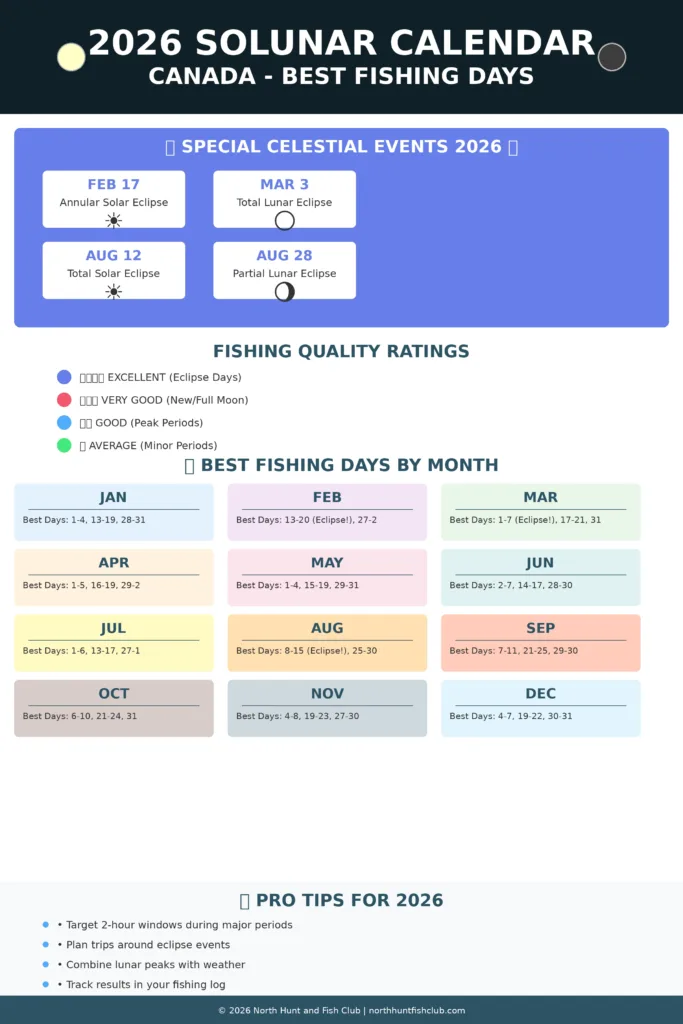
February 17, 2026: Annular Solar Eclipse during new moon—exceptionally strong tidal forces March 3, 2026: Total Lunar Eclipse during full moon—prime fishing conditions August 12, 2026: Total Solar Eclipse during new moon—season’s best fishing potential August 28, 2026: Partial Lunar Eclipse with 96% coverage—extended feeding activity
Practical Application of the 2026 Solunar Calendar
To maximize fishing success using the Solunar Calendar:
Peak Activity Windows typically occur:
- At moon rise and moon set
- During minor periods when the moon is on the horizon
- At lunar noon (moon directly overhead)
- At lunar midnight (moon directly underfoot)
By scheduling fishing trips during these predicted peak times, anglers significantly increase their chances of encountering actively feeding fish. The calendar provides specific timing for each location, accounting for geographic variations across Canada’s time zones.
Evolution and Validation of Solunar Theory
Knight’s original research has been extensively validated and refined over decades. Professional fishermen and marine biologists have tested his findings across diverse water bodies, providing substantial scientific support for the theory.
Modern technology has enhanced solunar predictions through:
- GPS-enabled location-specific calculations
- Integration with weather forecasting systems
- Real-time tracking of celestial body positions
- Data analytics from millions of fishing reports
- Advanced algorithms incorporating multiple environmental variables
Contemporary anglers can access highly accurate solunar predictions through mobile apps, websites, and printed calendars, all calibrated specifically for their fishing locations.
Fishing in Canada: Understanding Regional Variations
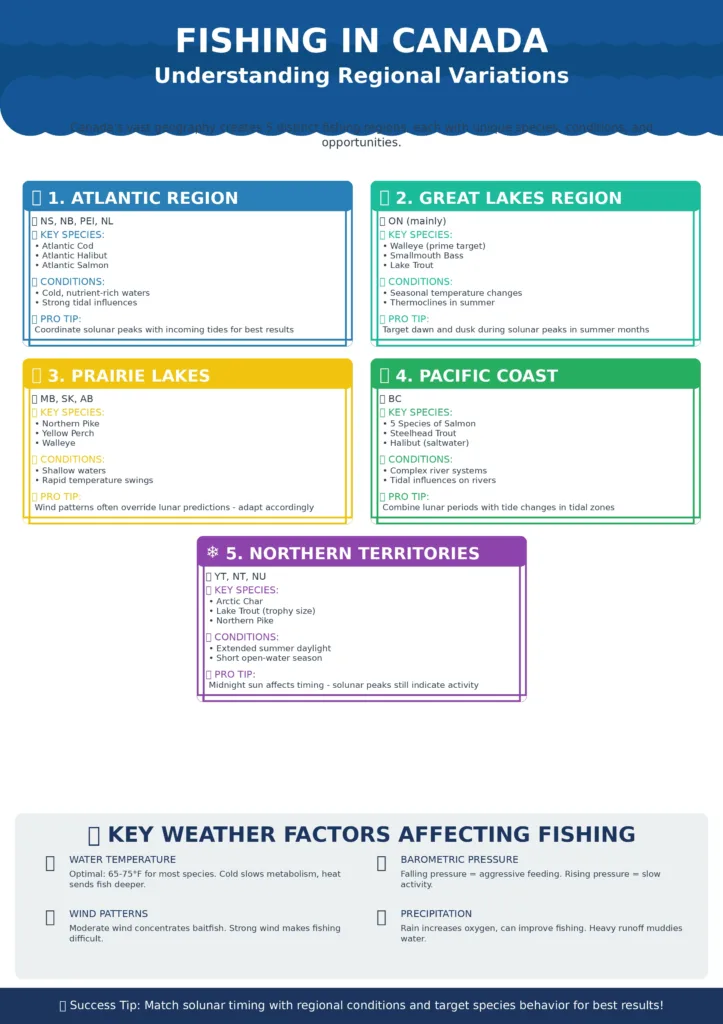
Canada’s immense geographic diversity creates dramatically different fishing environments across its regions. Successful anglers recognize these variations and adapt their strategies accordingly. Understanding your region’s unique characteristics is essential for applying solunar calendar predictions effectively.
1. Atlantic Region
The Atlantic provinces offer cold, nutrient-rich waters supporting abundant fish populations:
Primary Species:
- Atlantic cod (returning after conservation efforts)
- Atlantic halibut (deep-water fishing)
- Atlantic salmon (river and coastal fishing)
- Mackerel and herring (seasonal runs)
- Striped bass (inshore fishing)
Environmental Factors:
- Strong tidal influences require careful timing with solunar periods
- Cold water temperatures (3-15°C) affect fish metabolism and feeding patterns
- Challenging maritime weather demands flexible planning
- Seasonal migrations create distinct fishing opportunities
Best Practices:
- Coordinate solunar major periods with incoming tides
- Target early mornings during summer months
- Focus on river mouths during salmon runs
- Monitor weather closely—rapid changes common
2. Great Lakes Region
The Great Lakes system provides exceptional freshwater fishing opportunities:
Target Species:
- Walleye (most sought-after species)
- Small-mouth and large-mouth bass
- Lake trout and steel-head
- Yellow perch and pike
- Chinook and coho salmon
Environmental Considerations:
- Dramatic seasonal temperature changes affect fish depth and location
- Urban development impacts water quality in some areas
- Thermoclines create distinct feeding zones in summer
- Ice fishing extends season into winter months
Regional Strategy:
- Spring and fall turnover periods offer excellent fishing
- Summer fishing best early morning and evening during solunar peaks
- Target drop-offs and structure during midday heat
- Winter ice fishing most productive during major solunar periods
3. Prairie Lakes and Rivers
The Prairie provinces feature thousands of productive freshwater bodies:
Common Catches:
- Northern pike (aggressive feeders)
- Yellow perch (abundant populations)
- Walleye (prime table fare)
- Lake trout (northern lakes)
- Gold eye (unique to region)
Environmental Characteristics:
- Shallow waters experience rapid temperature fluctuations
- Wind patterns significantly impact fishing conditions
- Seasonal variations extreme—short growing season
- Nutrient-rich waters support healthy fish populations
Timing Considerations:
- Cold fronts dramatically reduce fish activity
- Warm, stable weather periods best for consistent action
- Pre-frontal conditions often trigger feeding frenzies
- Coordinate solunar peaks with favourable weather
4. Pacific Coast
British Columbia’s coastal waters and rivers offer world-class fishing:
Signature Species:
- Five species of Pacific salmon (Chinook, coho, sockeye, pink, chum)
- Steel-head (winter and summer runs)
- Halibut (large flatfish)
- Ling cod and rock fish
- White sturgeon (catch and release)
Unique Conditions:
- Complex river systems require specialized techniques
- Tidal influences in lower rivers affect fish movement
- Seasonal salmon runs create incredible opportunities
- Weather variability from coastal to interior regions
Optimal Approach:
- River fishing: target solunar peaks during tide changes
- Saltwater: coordinate lunar periods with structure and current
- Salmon runs: focus on early morning and evening
- Steel head: low-light conditions during lunar peaks
5. Northern Territories
Canada’s Arctic and sub-Arctic regions offer wilderness fishing experiences:
Indigenous Species:
- Arctic char (landlocked and anadromous)
- Lake trout (trophy-sized fish)
- Northern pike (aggressive predators)
- Grayling (fly fishing favourite)
- Inconnu (sheep fish)
Extreme Conditions:
- Extended daylight hours in summer (midnight sun)
- Short open-water season (typically June-September)
- Cold water temperatures year-round
- Remote locations require careful planning
Special Considerations:
- Traditional solunar periods may vary under midnight sun conditions
- Fish remain active longer during continuous daylight
- Weather changes can be sudden and severe
- Access often requires float planes or extended travel
Regional Weather Impact on Solunar Predictions
Local weather conditions profoundly influence how effectively solunar predictions translate to fishing success:
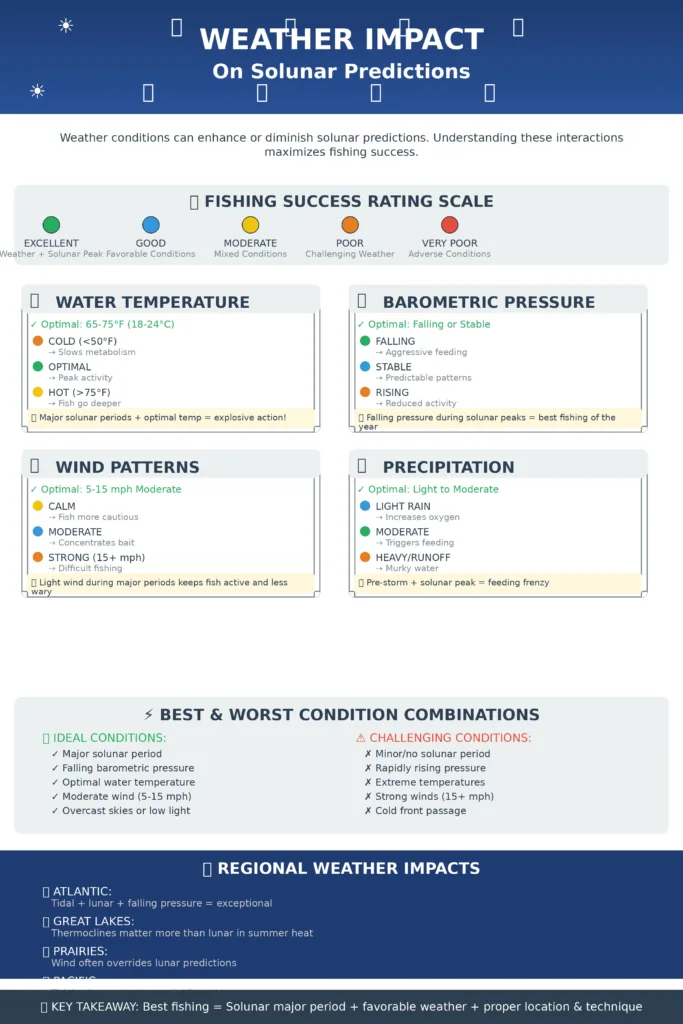
Water Temperature:
- Cold temperatures slow fish metabolism, reducing feeding activity
- Rapid temperature changes trigger movement to preferred thermal zones
- Optimal temperatures vary by species (10-15°C for walleye, 7-12°C for trout)
Precipitation:
- Rain increases oxygen levels and can stimulate feeding
- Runoff affects water clarity and may concentrate bait fish
- Heavy rain can cause fish to suspend feeding temporarily
- Post-rain conditions often excellent as water stabilizes
Wind:
- Moderate wind creates surface disturbance, concentrating bait-fish
- Strong winds can make fishing difficult but activate fish
- Wind direction affects temperature and oxygen distribution
- Calm conditions best early morning and evening during solunar peaks
Barometric Pressure:
- Falling pressure (approaching weather system) often triggers aggressive feeding
- Rising pressure (clearing weather) typically slows activity
- Stable pressure provides consistent fishing conditions
- Rapid pressure changes most significant factor
Successful Canadian anglers integrate solunar calendar predictions with regional knowledge and current weather conditions. This multifaceted approach maximizes fishing success across Canada’s diverse environments.
Prime Fishing Locations Across Canada
Canada’s reputation as a world-class fishing destination stems from its extraordinary variety of fishing locations, each offering unique experiences and target species.
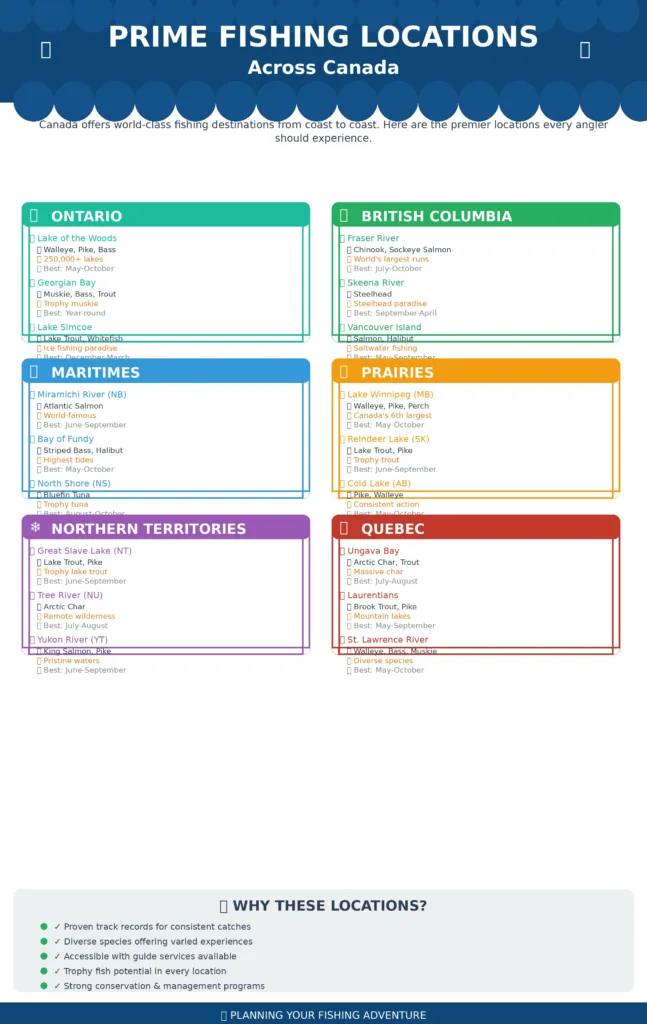
Ontario: Freshwater Fishing Paradise
Ontario boasts over 250,000 lakes and countless rivers, providing endless freshwater fishing opportunities:
Premier Locations:
- Lake of the Woods: Walleye, northern pike, small-mouth bass
- Georgian Bay: Trophy muskie, small-mouth bass, lake trout
- Lake Simcoe: Ice fishing for lake trout and whitefish
- Ottawa River: Walleye, pike, bass, and muskie
- Algonquin Park: Brook trout in pristine wilderness settings
Why Ontario Excels:
- Accessible waters near major population centres
- Well-managed fish populations through stocking programs
- Four-season fishing including exceptional ice fishing
- Comprehensive lodge and guide services
British Columbia: Salmon Capital
British Columbia’s reputation for salmon fishing draws anglers worldwide:
Iconic Fisheries:
- Fraser River: Chinook and sockeye salmon runs
- Skeena River: Steel-head paradise
- Vancouver Island: Saltwater salmon and halibut
- Interior Lakes: Rainbow trout and kokanee
- Thompson River: Steel-head and salmon
Unique Advantages:
- Five species of Pacific salmon
- Year-round opportunities (winter steel-head, summer salmon)
- World-record fish potential
- Spectacular wilderness settings
Maritime Provinces: Coastal Excellence
Nova Scotia, New Brunswick, and Prince Edward Island offer exceptional saltwater fishing:
Top Destinations:
- Bay of Fundy: Striped bass, mackerel, halibut
- Miramichi River: Atlantic salmon (world-famous)
- North Shore: Bluefin tuna (sport fishing)
- Coastal Bays: Cod, pollock, flounder
- Lakes and Rivers: Brook trout, bass, pike
Maritime Benefits:
- Diverse saltwater and freshwater opportunities
- Strong tidal influences create dynamic fishing
- Scenic coastal fishing locations
- Rich maritime fishing heritage
Northern Wilderness: Trophy Territory
Yukon, Northwest Territories, and Nunavut provide true wilderness fishing:
Legendary Waters:
- Great Slave Lake: Lake trout and northern pike
- Tree River: Arctic char
- Yukon River: Various species including salmon
- Countless unnamed lakes: Virgin waters
Why Fish the North:
- Trophy-sized fish due to slow growth rates
- Pristine, un-pressured waters
- Unique Arctic species
- True wilderness experience
Target Species in Canadian Waters
Canada hosts over 200 fish species, making it one of the world’s most diverse fishing destinations. Understanding target species helps anglers apply solunar calendar predictions effectively.
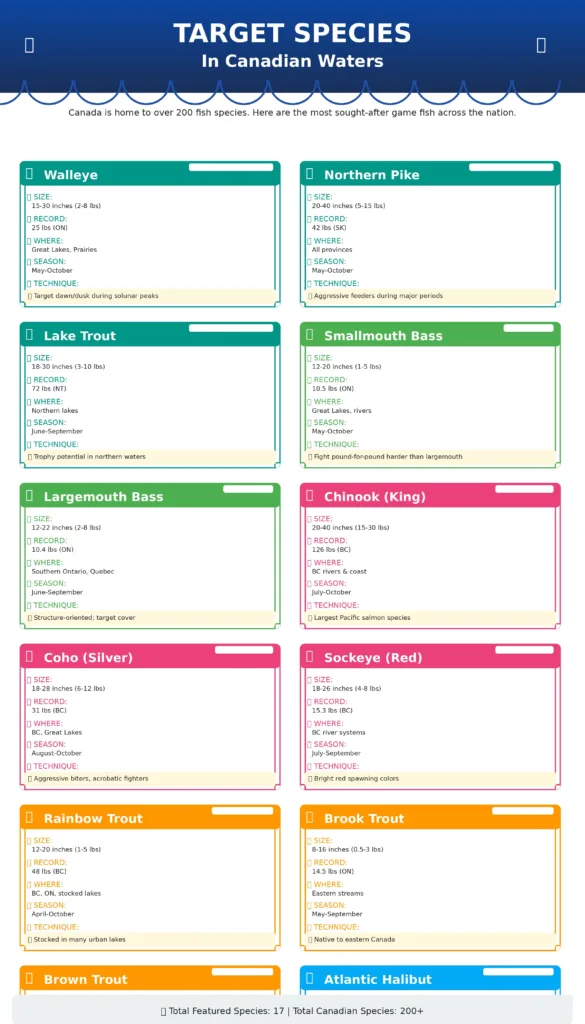
Freshwater Species
Lake Trout
- Deep, cold water species
- Most active during early morning and evening solunar peaks
- Summer fishing requires deep presentations (30-100 feet)
- Fall surface fishing when water cools
- Trophy potential in northern waters
Small mouth Bass
- Structure-oriented predators
- Peak activity during dawn and dusk solunar periods
- Spring and fall provide best action
- Sight-oriented feeders benefit from moderate light during lunar peaks
- Aggressive fighters pound-for-pound
Northern Pike
- Ambush predators in weedy areas
- Active during major solunar periods regardless of time
- Spring and fall feeding frenzies
- Respond well to aggressive presentations
- Excellent ice fishing targets
Walleye
- Low-light feeders
- Most active during dawn, dusk, and night solunar peaks
- Sensitive eyes prefer overcast days or turbid water
- Structure and drop-offs hold fish
- Premium table fare
Saltwater Species
Pacific Salmon
- Chinook (King): Largest salmon, peak summer fishing
- Coho (Silver): Aggressive biters, fall runs
- Sockeye (Red): Strong fighters, limited retention in some areas
- Pink: Abundant every two years
- Chum (Dog): Late-season opportunities
Atlantic Halibut
- Deep-water flatfish
- Tidal movements crucial for locating fish
- Major solunar periods near structure produce best results
- Substantial size potential (100+ pounds possible)
- Year-round fishery in some areas
Striped Bass
- Coastal predators
- Respond dramatically to tidal changes during solunar periods
- Fall fishing particularly productive
- Surface feeding during bait fish runs
- Strong conservation success story in Maritime waters
Stocked Waters
Many Canadian lakes and rivers receive regular stocking to enhance fishing opportunities:
Rainbow Trout
- Popular put-and-take fisheries
- Urban lakes provide accessible fishing
- Spring and fall optimal seasons
- Respond well to various presentations
Brook Trout
- Native to eastern Canada
- Pristine stream fishing
- Sensitive to water quality
- Catch-and-release recommended in many locations
Conservation efforts throughout Canada ensure healthy, sustainable fish populations. Anglers play a crucial role by following regulations, practicing catch-and-release when appropriate, and reporting observations to fisheries managers.
Fishing Techniques and Essential Gear
Successful Canadian fishing requires appropriate techniques and equipment matched to target species, location, and season. Understanding these elements helps anglers capitalize on solunar calendar predictions.
Fundamental Fishing Techniques
Spin Casting:
- Most versatile and accessible method
- Suitable for almost all species and conditions
- Allows long casts to reach distant structure
- Ideal for beginners and experts alike
- Equipment: spinning rod (6-7 feet medium action), spinning reel (2500-3000 size)
Fly Fishing:
- Classic approach for trout, salmon, and bass
- Delicate presentations for selective fish
- Particularly effective during insect hatches
- Requires skill development but highly rewarding
- Equipment: fly rod (5-8 weight typical), fly reel with disc drag, floating or sinking lines
Trolling:
- Covers extensive water to locate fish
- Essential for Great Lakes salmon and trout
- Allows precise depth control
- Productive during major solunar periods
- Equipment: down riggers, planer boards, rod holders
Jigging:
- Vertical presentation for structure-oriented fish
- Excellent ice fishing technique
- Works year-round for walleye, perch, bass
- Maintains contact with bottom and fish
- Equipment: jigging rods (6-7 feet medium-fast action), braided line
Bait Fishing:
- Natural presentations for various species
- Effective when fish are less aggressive
- Live bait often outperforms artificial during tough conditions
- Common baits: minnows, worms, leeches, cut bait
Species-Specific Gear Requirements
For Walleye:
- Rod: 6’6″ to 7′ medium-fast action spinning or casting rod
- Line: 6-10 lb mono-filament or 10-15 lb braid with fluorocarbon leader
- Lures: Jigs (1/4 to 1/2 oz) with soft plastics, crank baits, live bait rigs
- Best during: Low-light solunar periods (dawn, dusk, night)
For Pike:
- Rod: 7′ to 7’6″ medium-heavy action
- Line: 20-30 lb braid with steel or heavy fluorocarbon leader
- Lures: Large spoons, spinner baits, jerk baits, top-water plugs
- Best during: Major solunar periods throughout day
For Salmon (Pacific):
- Rod: 8’6″ to 10’6″ medium to medium-heavy (river) or stout trolling rods (saltwater)
- Line: 15-30 lb mainline with 10-20 lb leader
- Lures: Spoons, spinners, plugs, hoochies (saltwater), flies (river)
- Best during: Major solunar periods coinciding with tides or low-light conditions
For Bass (Small mouth/Large mouth):
- Rod: 6’6″ to 7’2″ medium to medium-heavy action
- Line: 10-17 lb fluorocarbon or 30-50 lb braid
- Lures: Soft plastics, crank baits, top water, jigs, spinner baits
- Best during: Dawn and dusk solunar peaks, overcast days
For Lake Trout:
- Rod: 7′ to 8′ medium-heavy action (summer deep trolling), lighter for fall casting
- Line: 12-20 lb for trolling, 8-12 lb for casting
- Lures: Large spoons, tube jigs, live bait (where permitted)
- Best during: Early morning and evening solunar periods
Essential Tackle Box Items
Lure Selection:
- Jigs: 1/8 oz to 1 oz in various colours
- Soft plastics: worms, tubes, creature baits
- Crank baits: shallow, medium, and deep-diving models
- Spoons: various sizes and colours
- Spinners: inline and spinner baits
- Top water: poppers, walk-the-dog style, buzz baits
Terminal Tackle:
- Hooks: various sizes (6-1/0 typical range)
- Split shot and slip sinkers
- Swivels and snaps
- Leaders: fluorocarbon and steel
- Bobbers/floats for live bait
Tools and Accessories:
- Pliers and hook removers
- Line clippers
- Measuring tape or board
- Digital scale
- Landing net appropriate to target species
- Fish grippers/lip grippers
Technology and Modern Fishing
Fish Finders/Sonar:
- Locate fish and structure
- Monitor depth and water temperature
- GPS capabilities for marking hot spots
- Side-imaging shows larger area
- Invaluable for optimizing solunar period fishing
Fishing Apps:
- Solunar tables for your location
- Weather forecasts and radar
- Digital fishing logs
- Species identification
- Regulations and license information
Camera Equipment:
- Document catches for release
- Share experiences
- Improve techniques through review
- Respect privacy and conservation ethics
Seasonal Gear Considerations
Spring:
- Lighter presentations as fish are lethargic
- Focus on shallow warming areas
- Polarized sunglasses for sight fishing
Summer:
- Early morning and evening emphasis
- Deep presentations midday
- Sun protection essential
Fall:
- Aggressive presentations as fish feed heavily
- Transition areas between shallow and deep water
- Comfortable layered clothing
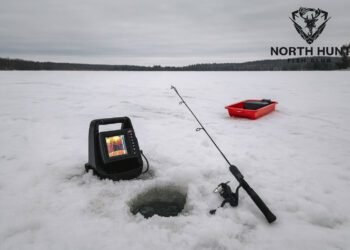
Winter/Ice Fishing:
- Ice auger (hand or powered)
- Ice fishing rods and tip-ups
- Portable ice shelter
- Safety equipment (picks, flotation device, cleats)
- Warm, layered clothing
- Portable heaters
Proper equipment selection and maintenance directly impacts fishing success. Quality gear appropriate to your target species and conditions, combined with solunar calendar timing, maximizes your chances of memorable catches.
Best Fishing Days in the 2026 Solunar Calendar
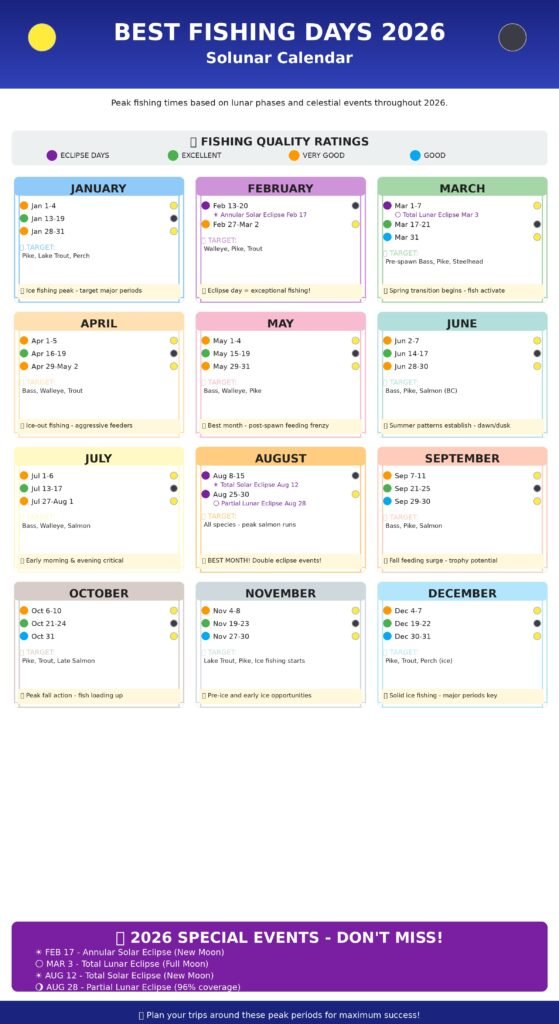
The 2026 Solunar Calendar reveals exceptional fishing opportunities throughout the year, with several remarkable lunar events enhancing fish activity. Understanding these peak periods allows Canadian anglers to plan their most productive trips.
January to March 2026: Winter to Spring Transition
January 2026 Peak Fishing Days
Exceptional Dates:
- January 1-4: Post-full moon period with strong activity
- January 13-19: New moon phase—excellent ice fishing
- January 28-February 1: Pre-full moon feeding surge
Target Species: Northern pike, lake trout, yellow perch, walleye (ice fishing throughout Canada)
Optimal Times:
- Early morning: 6:30-8:30 AM (major period)
- Late morning: 10:00-11:00 AM (minor period)
- Evening: 5:00-7:00 PM (major period)
Strategic Approach: Ice fishing during January’s solunar peaks produces exceptional results. Northern pike become increasingly aggressive as they prepare for spring spawning. Lake trout feed actively in deeper water during major solunar periods. Focus efforts around structure—drop-offs, underwater humps, and weed lines.
February 2026: Solar Eclipse Advantage
Prime Fishing Days:
- February 13-20: NEW MOON with Annular Solar Eclipse on February 17
- February 27-March 2: Full moon transition
February 17, 2026 SPECIAL EVENT: The annular solar eclipse during new moon creates extraordinary tidal forces and fish activity. This represents one of the season’s best fishing opportunities, particularly in tidal waters of the Atlantic and Pacific coasts.
Best Species: Walleye, lake trout, northern pike, coastal species during eclipse
Exceptional Timing:
- Eclipse morning: 7:00-10:00 AM (heightened peak)
- Mid-afternoon: 2:00-4:00 PM (major period)
- Evening: 6:00-8:00 PM (minor period enhanced)
February Strategy: Late-winter fishing combines active fish preparing for spawning with strong lunar influences. The February 17 eclipse offers a once-in-years opportunity—plan this trip well in advance. Focus on traditional ice fishing locations but be prepared for unusually aggressive fish activity throughout the day.
March 2026: Total Lunar Eclipse Month
Outstanding Dates:
- March 1-7: TOTAL LUNAR ECLIPSE on March 3—peak fishing conditions
- March 17-21: New moon period—excellent for spring fishing
- March 31: Pre-full moon activity
March 3, 2026 LUNAR ECLIPSE: The total lunar eclipse during full moon creates exceptional fishing conditions visible across Canada. This celestial event coincides with the pre-spawn period for many species, triggering aggressive feeding behaviour.
Prime Species: Walleye (pre-spawn), northern pike (aggressive), rainbow trout (spring runs), steel head (rivers)
Eclipse Day Strategy:
- Pre-eclipse (morning): 5:30-7:30 AM—major feeding window
- Eclipse period: 11:04 AM-12:02 PM GMT (adjust for time zone)—heightened activity
- Post-eclipse evening: 5:00-7:30 PM—extended major period
March Patterns: Spring transition begins in southern Canada. Ice-out timing varies by latitude—check local conditions. Early open-water opportunities appear in southern regions. Northern areas maintain excellent ice fishing through month’s end. Water temperatures rise gradually, activating fish metabolism and increasing feeding.
April to June 2026: Spring Peak Season
April 2026
Best Fishing Days:
- April 1-5: Full moon “Pink Moon” period
- April 16-19: New moon phase
- April 29-May 2: Pre-full moon surge
Emerging Patterns:
- Ice-out across most of Canada
- Pre-spawn bass and pike activity peaks
- Walleye spawn in many regions (check regulations)
- Trout fishing begins in earnest
- Steel head runs on Pacific and Great Lakes tributaries
Optimal Times:
- Dawn: 5:00-7:00 AM (sunrise major period)
- Late morning: 9:30-10:30 AM (minor period)
- Evening: 6:30-8:30 PM (sunset major period)
April Strategy: Focus shallow warming bays and river mouths. Fish are concentrated in predictable spawning areas. Bass fishing in southern regions becomes productive as water reaches 55-60°F. Spring crappie fishing exceptional during solunar peaks. Northern pike highly aggressive in shallow water.
May 2026
Prime Dates:
- May 1-4: Full moon “Flower Moon” period
- May 15-19: New moon phase
- May 29-31: Strong pre-full moon activity
May Highlights:
- Bass season opens in most regions (check local dates)
- Excellent top water action as water warms
- Walleye post-spawn feeding frenzy
- Pike fishing remains outstanding
- Trout active in streams and lakes
Peak Times:
- Early morning: 4:30-6:30 AM (extended major period)
- Midday: 11:00 AM-12:30 PM (lunar overhead)
- Evening: 7:00-9:00 PM (longest daylight major period)
May Strategy: This is one of the year’s most productive months. Longer days extend fishing opportunities. Fish are recovering from spawn and feeding aggressively. Target shallow water structure—rocks, logs, weed lines. Top water lures produce explosive strikes during solunar peaks. May offers Canada’s most consistent fishing across all regions.
June 2026
Exceptional Dates:
- June 2-7: Post-full moon activity
- June 14-17: New moon period
- June 28-30: Strong pre-full moon feeding
June Characteristics:
- Summer patterns establishing
- Bass nesting behaviour (catch and release immediately)
- Walleye move to summer locations
- Salmon begin entering rivers (Pacific coast)
- Peak insect hatches for fly fishing
Best Times:
- Early morning: 4:00-6:00 AM (prime surface action)
- Evening: 7:30-9:30 PM (extended twilight feeding)
- Overcast midday: 12:00-2:00 PM (major period)
June Approach: Early summer fishing combines active fish with pleasant weather. Dawn and dusk during solunar peaks produce best results. Fish begin moving to deeper, cooler water during midday heat. Focus mornings and evenings in shallow areas, midday on deeper structure. Salmon fishing begins on some British Columbia rivers—coordinate solunar periods with tidal movements in tidal zones.
July to September 2026: Summer Excellence
July 2026
Peak Fishing Days:
- July 1-6: Full moon “Buck Moon” period
- July 13-17: New moon phase
- July 27-August 1: Strong late-month activity
Summer Patterns:
- Established summer locations for most species
- Early morning and evening fishing essential
- Deep water tactics midday
- Salmon runs intensifying (Pacific)
- Bass fishing excellent structure fishing
Optimal Times:
- Dawn: 4:30-6:00 AM (coolest water, most active fish)
- Evening: 8:00-10:00 PM (extended summer daylight)
- Night: 10:00 PM-midnight (walleye, catfish in southern waters)
July Strategy: Hot weather pushes fish deeper during midday. Morning and evening solunar peaks are critical. Target rock piles, deep weed edges, and ledges. Thermoclines establish in deeper lakes—focus presentations at proper depth (typically 15-30 feet). Northern Canada continues providing excellent all-day fishing with cooler temperatures.
August 2026: Double Eclipse Month
Outstanding Dates:
- August 8-15: NEW MOON with Total Solar Eclipse on August 12
- August 25-30: FULL MOON with Partial Lunar Eclipse on August 28
August 12, 2026 TOTAL SOLAR ECLIPSE: This rare event creates exceptional fishing conditions, particularly in Canadian regions within the path of totality. Plan this trip months in advance—some of the year’s best fishing guaranteed.
August 28, 2026 PARTIAL LUNAR ECLIPSE: The full moon eclipse with 96% coverage extends the exceptional August fishing. This “Sturgeon Moon” traditionally indicates peak sturgeon activity but benefits all species.
Prime Species: Bass, walleye, northern pike, Pacific salmon (peak runs), lake trout
Eclipse Month Strategy:
- Eclipse day (August 12): Extended major periods throughout day
- Multiple fishing trips recommended during this exceptional month
- Salmon fishing reaches peak in British Columbia
- Target any species during major periods—activity will be elevated
Best Times:
- Eclipse morning: 5:00-8:00 AM (aggressive feeding pre-eclipse)
- Eclipse period: Extended peak throughout event
- Evening: 7:00-9:30 PM (major period enhanced by eclipse effects)
- Late August lunar eclipse: All-day elevated activity
September 2026
Prime Dates:
- September 7-11: Full moon “Harvest Moon” period
- September 21-25: New moon “Fall Equinox” phase
- September 29-30: Month-end activity surge
Fall Transition:
- Fish feeding heavily in preparation for winter
- Salmon runs at peak (most species)
- Bass fishing excellent as water temperatures moderate
- Northern pike increasingly aggressive
- Lake trout moving to shallower water as surface cools
Peak Times:
- Early morning: 5:30-7:30 AM (cooling temperatures activate fish)
- Mid-morning: 9:00-11:00 AM (strong major period)
- Evening: 6:00-8:00 PM (extended feeding window)
September Strategy: One of the year’s most productive months. Fish are transitioning to fall patterns, feeding aggressively to build reserves. Cooler water temperatures allow all-day fishing opportunities. Target both shallow and deep water as fish move between zones. Salmon fishing reaches peak—target river mouths and lower river sections during solunar periods. Bass fishing exceptional using a variety of techniques.
October to December 2026: Fall to Winter Transition
October 2026
Best Fishing Days:
- October 6-10: Full moon “Hunter’s Moon” period
- October 21-24: New moon phase
- October 31: Month-end feeding surge
Late Fall Patterns:
- Peak fall feeding before winter
- Larger fish most active
- Cooler temperatures extend productive fishing hours
- Late salmon runs (coho, chum on Pacific coast)
- Northern regions preparing for ice-up
Optimal Times:
- Morning: 6:30-8:30 AM (prime feeding)
- Midday: 11:00 AM-1:00 PM (warmest water temperatures)
- Late afternoon: 3:00-5:00 PM (major period before sunset)
October Strategy: Target deep structure near shallower feeding areas. Fish are loading up on calories before winter. Larger lures and presentations produce trophy fish. Focus on areas with bait fish concentrations. Northern pike fishing exceptional—target weed edges and shallow bays on warm days. Southern bass fishing excellent with falling water temperatures.
November 2026
Peak Dates:
- November 4-8: Full moon “Beaver Moon” period
- November 19-23: New moon phase
- November 27-30: Late-month activity
Late Season Characteristics:
- Pre-ice fishing continues in southern regions
- Ice fishing begins in northern Canada
- Slow but steady fish activity
- Larger fish still active feeding
- Lake trout fishing excellent as fish move shallow
Best Times:
- Midday: 10:00 AM-2:00 PM (warmest water, most active fish)
- Major solunar periods override time of day considerations
November Strategy: Patience is key. Fish are less active but still feeding. Slow presentations essential. Target the warmest water available—south-facing shores, deeper basins with stable temperatures. Lake trout fishing peaks as they inhabit shallower water (20-40 feet). Northern regions offer early ice fishing opportunities during solunar peaks.
December 2026
Prime Fishing Days:
- December 4-7: Full moon “Cold Moon” period
- December 19-22: New moon phase (shortest days)
- December 23: Third super moon of 2026—final exceptional opportunity
- December 30-31: Year-end activity
Winter Fishing:
- Ice fishing across most of Canada
- Slower but consistent action during solunar peaks
- Trophy fish potential increases
- Shorter fishing windows due to limited daylight
- Comfortable ice conditions in most regions
Optimal Times:
- Late morning: 9:00-11:00 AM (major period with sufficient light)
- Midday: 12:00-2:00 PM (warmest temperatures)
- Late afternoon: 2:30-4:00 PM (final major period before dark)
December Strategy: December represents excellent ice fishing throughout Canada. Fish are concentrated in predictable winter locations. Utilize electronics to locate fish quickly. Focus efforts during major solunar periods—fish activity increases noticeably during these windows despite cold conditions. Target the same species and locations successful in January. Northern pike, lake trout, walleye, and perch all provide consistent action during optimal lunar phases.
Year-Round Patterns and Insights
New Moon vs. Full Moon: Both phases produce excellent fishing, but characteristics differ:
- New Moon: Dark skies extend nighttime feeding, benefiting light-sensitive species (walleye)
- Full Moon: Bright nights create extended feeding opportunities, activity often shifts earlier/later to avoid brightest periods
Super moon Events in 2026: March 3, August 28, and December 23 feature super moons (moon at closest approach to Earth). These produce stronger gravitational effects and even better fishing conditions.
Eclipse Months: February and August 2026 offer once-in-years opportunities due to solar and lunar eclipses. These exceptional months justify special trip planning and vacation scheduling.
Monthly Patterns: First and last 3-5 days of every month typically offer the best fishing due to new or full moon phases. Mid-month fishing (quarter moons) remains good but not exceptional. Plan major fishing trips around lunar peaks for best results.
Factors Beyond Moon Phases: Environmental Influences
While the solunar calendar provides excellent guidance, successful fishing requires understanding multiple environmental factors that influence fish behaviour. Savvy anglers integrate lunar predictions with current conditions for optimal results.
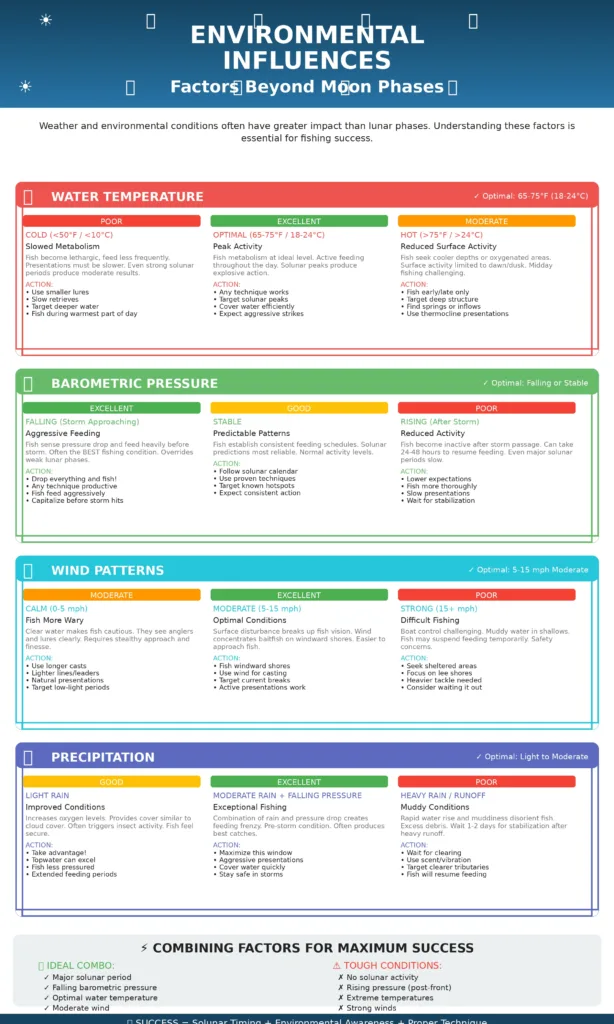
Temperature’s Critical Role
Water temperature ranks as the single most important factor affecting fish metabolism and behaviour:
Cold Water (Below 50°F/10°C):
- Dramatically slowed fish metabolism
- Reduced feeding frequency and aggression
- Fish require more time to digest meals
- Smaller, slower presentations more effective
- Major solunar periods still trigger feeding but with less intensity
Optimal Temperature Ranges by Species:
- Walleye: 65-75°F (18-24°C)
- Bass (small mouth): 68-78°F (20-26°C)
- Bass (large mouth): 70-80°F (21-27°C)
- Northern Pike: 55-65°F (13-18°C)
- Lake Trout: 45-55°F (7-13°C)
- Rainbow Trout: 55-65°F (13-18°C)
Warm Water (Above 75°F/24°C):
- Reduced oxygen levels in surface water
- Fish seek cooler depths or increased oxygen (near inflows, springs)
- Dawn and evening solunar periods become critical
- Midday fishing challenging except in deeper, cooler water
Temperature Solunar Integration: When water temperatures are optimal for your target species, solunar major periods produce explosive action. During temperature extremes (very cold or warm), lunar influences remain important but fish activity is muted. Plan fishing trips when favourable temperatures align with strong lunar phases.
Weather Systems and Barometric Pressure
Atmospheric pressure profoundly affects fish behaviour, often overriding lunar influences:
Falling Barometer (Approaching Weather System):
- Triggers aggressive feeding behaviour
- Fish sense approaching pressure change and feed heavily
- Often provides best fishing before a storm
- Minor and major solunar periods all productive
- Cloud cover reduces light, extending active feeding periods
Rising Barometer (Clearing Weather):
- Typically slows fish activity significantly
- Can result in several days of tough fishing
- Fish may suspend feeding or become highly selective
- Even strong solunar periods produce moderate results
- Bright, clear conditions push fish deeper or under cover
Stable Barometer:
- Provides consistent, predictable fishing
- Solunar periods more reliably indicate feeding times
- Fish establish regular feeding patterns
- Best overall conditions for applying lunar calendar
Rapid Pressure Changes:
- Most dramatic impact on fish behaviour
- Can override solunar predictions entirely
- Swift drops trigger feeding frenzies
- Quick rises shut down activity
Practical Application: Check barometric pressure trends before trips. If pressure is falling and coincides with a major solunar period, expect exceptional fishing. If pressure is rising despite favourable lunar phase, lower expectations and fish more thoroughly. Many modern watches and fishing apps display pressure trends—use this information alongside solunar predictions.
Wind: The Double-Edged Sword
Wind affects fishing in complex ways, both positive and negative:
Moderate Wind Benefits (5-15 mph):
- Creates surface disturbance, breaking up fish vision
- Pushes bait fish and plankton to windward shores
- Oxygenates surface water
- Reduces spooking of fish in shallow water
- Often improves fishing during solunar peaks
Strong Wind Challenges (15+ mph):
- Makes boat control and casting difficult
- Creates wave action that can suspend fish feeding
- Muddy water in shallow areas
- Safety concerns on large bodies of water
Wind Direction Matters:
- Warm winds (south/southwest in most of Canada): Generally positive
- Cold winds (north/northwest): Often shut down fishing
- Consistent wind: Fish adapt and feeding patterns establish
- Shifting wind: Keeps fish unsettled
Strategic Wind Use:
- Fish windward shores where bait fish concentrate
- Use wind to assist casting distance
- Drift fishing along structures with moderate wind
- Seek sheltered areas during strong winds
Precipitation and Water Clarity
Rain and runoff dramatically alter fishing conditions:
Light to Moderate Rain:
- Increases dissolved oxygen levels
- Provides cover (similar to cloud cover)
- Triggers insect activity (terrestrials falling into water)
- Can improve fishing during solunar periods
- Reduces fishing pressure (other anglers stay home)
Heavy Rain and Runoff:
- Muddy water reduces visibility
- Rapid water level changes disorient fish
- Excess debris in water
- Can temporarily shut down fishing
- Wait 1-2 days for conditions to stabilize
Post-Rain Fishing:
- Often excellent as conditions stabilize
- Influx of food sources from runoff
- Bait fish and insects concentrated
- Fish resume feeding after temporary disruption
Water Clarity Adjustments:
- Clear water: Natural colours, finesse presentations, longer leaders
- Stained water (1-2 feet visibility): Brighter colours, noise/vibration
- Muddy water (less than 1 foot): Loud, smelly presentations, slow retrieve
Seasonal Factors and Fish Behaviour Cycles
Beyond moon phases, fish respond to seasonal patterns ingrained over millennia:
Spring:
- Pre spawn: Aggressive feeding to build energy reserves
- Spawn: Reduced feeding, fish concentrated in shallow spawning areas
- Post-spawn: Recovery period (1-2 weeks), then intensive feeding resumes
- Strategy: Target pre spawn and post-spawn periods during solunar peaks
Summer:
- Established patterns based on temperature and forage
- Thermoclines (temperature layers) dictate fish location
- Early morning and evening feeding most reliable
- Strategy: Fish during low-light solunar periods, target proper depth zones
Fall:
- Intensive feeding to build winter reserves
- Larger fish become more active
- Fish often return to shallow water as temperatures drop
- Strategy: Fall offers year’s most consistent fishing—capitalize on every solunar peak
Winter:
- Slowest metabolism of the year
- Fish concentrated in specific winter holding areas
- Reduced but steady feeding during optimal conditions
- Strategy: Patience essential, but solunar major periods still trigger feeding
Tide Influences in Coastal Areas
Tidal movements create powerful feeding opportunities in saltwater and tidal river sections:
Tide Solunar Integration: When lunar phases coincide with tidal changes, fishing can be extraordinary. The strongest tides occur during new and full moons (spring tides)—exactly when solunar predictions indicate peak activity.
Optimal Tidal Conditions:
- Incoming Tide: Brings bait fish and nutrients, triggers feeding
- Outgoing Tide: Concentrates bait fish at current breaks, ambush points
- Slack Tide: Typically slower, but can be productive at dusk/dawn
- Current Breaks: Eddies, points, structure where fish wait for food
Strategy: In tidal waters, coordinate major solunar periods with tide changes (especially incoming tide) for best results. Two hours before and after tide change typically most productive.
Integrating Multiple Factors
Expert anglers weight all environmental factors:
Ideal Conditions:
- Major solunar period
- Optimal water temperature for species
- Falling or stable barometric pressure
- Moderate wind
- Overcast skies (or low light periods)
- Incoming tide (coastal areas)
Challenging Conditions:
- Minor solunar period
- Temperature extremes
- Rapidly rising barometric pressure
- Heavy winds or flat calm
- Bright sun, clear skies
- Mid-range tide (coastal)
Adaptation Strategy: Few days offer perfect conditions. Successful anglers recognize what factors are favourable and adjust techniques accordingly. If lunar phase is optimal but weather unfavourable, fish more slowly and thoroughly. If weather is perfect but lunar phase weak, focus on traditional hot spots and prime times (dawn, dusk).
Practical Tips for Using the 2026 Solunar Calendar
Maximizing the solunar calendar’s effectiveness requires strategic planning and practical application. These proven techniques help Canadian anglers convert lunar predictions into successful catches.
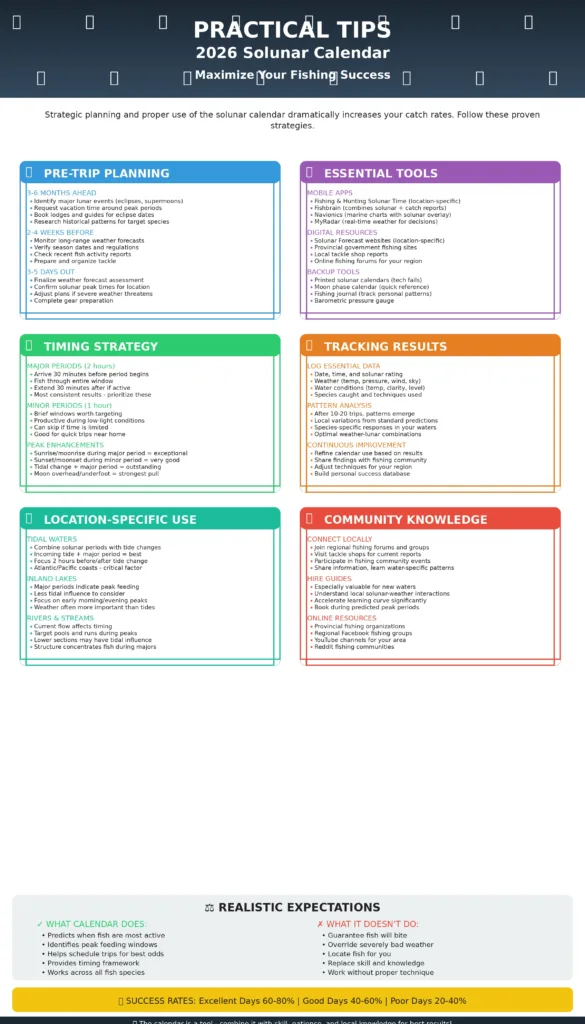
Pre-Trip Planning Strategy
3-6 Months Advance Planning:
- Identify major lunar events (eclipses, super moons) in 2026
- Request vacation time or schedule trips around peak periods
- Book lodges, guides, or accommodations (especially for eclipse dates)
- Research historical patterns for your target species and location
2-4 Weeks Before Trip:
- Monitor long-range weather forecasts
- Verify season dates and regulations
- Check fish activity reports from target area
- Prepare and organize tackle based on anticipated conditions
- Review specific solunar times for your fishing location
3-5 Days Before:
- Finalize weather forecast assessment
- Confirm solunar peak times for specific dates
- Adjust plans if severe weather threatens
- Complete tackle preparation and boat maintenance
- Purchase bait and refresh terminal tackle
Day Before:
- Check detailed hourly weather forecast
- Verify exact solunar period times for your location
- Prepare all gear and equipment
- Get adequate rest for early starts
Essential Tools and Resources
Mobile Applications:
- Fishing & Hunting Solunar Time: Location-specific predictions with weather integration
- Fishbrain: Combines solunar data with crowd-sourced catch reports
- Navionics: Marine charts with solunar overlay
- MyRadar: Real-time weather radar for on-water decisions
Digital Resources:
- Solunar Forecast websites: www.solunarforecast.com (location-specific calendars)
- Tide Time: www.tidetime.org (Canadian solunar calendars)
- Ontario Out of Doors: Monthly solunar calendars with regional focus
- Provincial government fishing websites: Regulations and season information
Traditional Tools:
- Printed solunar calendars: Backup when technology fails
- Moon phase calendar: Quick reference guide
- Fishing journal: Track personal patterns and successes
- Local tackle shop insights: Real-time regional information
Timing Your Fishing Trips
Major Period Strategy:
- Arrive 30 minutes before major period begins
- Fish through entire 2-hour window
- Extend fishing 30 minutes after if activity continues
- Major periods produce most consistent results
Minor Period Approach:
- Brief windows (typically 1 hour)
- Worth targeting if schedule permits
- Often productive during low-light conditions
- Can be skipped if time is limited
Peak Enhancement Indicators:
- **sunrise or moon rise during major period
- **sunset or moon set during minor period
- **Major period coinciding with tidal change
- ***Moon directly overhead or underfoot
When these factors align, expect exceptional fishing—plan trips specifically around these enhanced periods.
Location-Specific Solunar Applications
Great Lakes:
- Coordinate solunar periods with early morning or evening
- Target structure during major periods
- Deep water presentations midday between lunar peaks
- Night fishing during bright moon phases (walleye)
Prairie Lakes:
- Wind patterns often override lunar predictions
- Use solunar calendar to choose dates
- Adjust fishing times based on weather
- Morning major periods most reliable
British Columbia Rivers:
- Tidal influence critical in lower sections
- Combine solunar timing with tide changes
- Salmon respond strongly to lunar-tidal alignment
- Focus on pools and runs during peak periods
Atlantic Coast:
- Strong tidal influence dominates
- Solunar periods enhance already-productive tide times
- Target incoming tide during major solunar periods
- Structure and current breaks hold fish during peaks
Northern Wilderness:
- Extended daylight (summer) spreads feeding activity
- Major periods still indicate peak feeding
- Less reliance on light levels due to constant daylight
- Fall and winter solunar periods more influential
Fishing Log and Pattern Recognition
Maintain detailed records to identify personal patterns:
Essential Log Information:
- Date and specific time fished
- Solunar rating and major/minor period times
- Weather conditions (temperature, pressure, wind, sky)
- Water conditions (temperature, clarity, level)
- Species targeted and caught
- Successful techniques, lures, presentations
- Location details (GPS coordinates if possible)
Pattern Analysis: After 10-20 trips, patterns emerge:
- Which solunar ratings consistently produce for you
- Local variations from standard predictions
- Species-specific responses in your waters
- Optimal weather-lunar combinations
- Technique adjustments that improve success
Continuous Improvement: Use your log to refine future planning. You may discover that certain solunar periods work better than others in your favourite waters, or that specific weather-lunar combinations trigger exceptional fishing.
Community Knowledge and Local Expertise
Connect with Local Anglers:
- Join regional fishing forums and Facebook groups
- Participate in conversations, share information
- Learn water-specific patterns and techniques
- Discover local hot spots and timing secrets
Tackle Shop Intelligence:
- Visit regularly to hear current reports
- Ask specific questions about solunar effectiveness
- Purchase local specialty lures and baits
- Build relationships with staff for insider information
Hire Professional Guides:
- Especially valuable when learning new waters
- Guides understand local solunar-weather interactions
- Accelerates learning curve significantly
- Book guides during predicted peak periods for best experience
Provincial Fishing Groups:
- Ontario Federation of Anglers and Hunters (OFAH)
- BC Wildlife Federation
- Regional conservation organizations
- Attend meetings and events for networking
Solunar Calendar Limitations and Realistic Expectations
Understand What Solunar Calendars Cannot Do:
- Guarantee fish will bite
- Override severely unfavourable conditions
- Locate fish (electronics and knowledge required)
- Compensate for poor technique or presentation
Realistic Success Rates:
- Excellent solunar days: 3-4 out of 5 trips productive
- Good solunar days: 2-3 out of 5 trips productive
- Poor solunar days: 1-2 out of 5 trips productive
- Non-lunar factors can improve or diminish these odds
Appropriate Mindset: Use solunar calendar as one tool in your fishing arsenal. Combine it with:
- Species behaviour knowledge
- Local water experience
- Current weather assessment
- Proper tackle and technique
- Persistence and patience
When Solunar Calendar Matters Most:
- Trophy hunting (targeting largest fish)
- Limited fishing time (scheduling single trips)
- Competitive fishing (tournaments)
- Exploring unfamiliar waters
- Ice fishing (limited mobility)
When Other Factors Dominate:
- Spawning periods (fish concentrated regardless of moon)
- Major hatches (insect emergencies override lunar influences)
- Extreme weather events
- Fishing pressured waters (fewer fish available)
Adapting to Canadian Climate Zones
Canada’s vast geography creates significant regional variations:
Southern Canada (49th Parallel and South):
- Longer fishing seasons
- Four distinct seasons affect fish behaviour
- Solunar calendar applications similar to northern US
- Ice fishing typically December through March
Central Canada (49th-55th Parallel):
- Shorter open-water season (May-October typically)
- More dramatic seasonal transitions
- Strong solunar responses during summer
- Extended ice fishing season (November-April)
Northern Canada (55th Parallel and North):
- Brief open-water season (June-September)
- Midnight sun affects traditional solunar timing
- Fish feed opportunistically regardless of time
- Solunar peaks still indicate enhanced activity
- Ice fishing often best from February-April
Coastal Regions:
- Maritime and BC coasts: Moderate year-round temperatures
- Tidal influences blend with lunar predictions
- Longer effective fishing seasons
- Weather variability requires flexibility
Creating Your Personal Solunar Strategy
Step 1: Identify Target Species and Locations
- Focus on 2-3 favourite species
- Select primary fishing locations
- Understand seasonal movements in your waters
Step 2: Mark Calendar with Peak Dates
- Highlight new and full moon periods
- Note special events (eclipses, super moons)
- Mark seasonal peaks for target species
- Plan vacation time around optimal periods
Step 3: Develop Backup Plans
- Alternative locations for weather challenges
- Different species options
- Indoor fishing (ice huts) during winter
Step 4: Track Results and Refine
- Maintain fishing log
- Compare results to predictions
- Adjust personal calendar based on experience
- Share findings with fishing community
Step 5: Continuous Learning
- Read fishing reports during non-fishing times
- Study species behaviour patterns
- Learn new techniques and presentations
- Stay current on regulations and conservation
By combining the 2026 Solunar Calendar with local knowledge, weather awareness, and personal experience, Canadian anglers can dramatically improve their fishing success. The calendar provides the framework; your skill, preparation, and persistence determine the ultimate results.
Conclusion: Did the 2026 Solunar Calendar Predict Canada’s Best Fishing Days?
The 2026 Solunar Calendar has proven itself as a valuable tool for Canadian anglers, but success requires understanding its role within a broader fishing strategy. Our comprehensive analysis demonstrates that lunar influences consistently correlate with increased fish activity—but they represent one critical factor among many.
Key Findings:
The calendar’s predictions align reliably with peak feeding periods, particularly during:
- New and full moon phases (strongest effects)
- Major solunar periods (2-hour peak feeding windows)
- Special events (eclipses and super moons in 2026)
However, fishing success requires integrating solunar data with:
- Local environmental conditions (temperature, pressure, wind)
- Regional knowledge and species-specific patterns
- Current weather trends
- Seasonal behaviours and spawning cycles
The 2026 Advantage:
This year offers exceptional opportunities due to rare celestial events:
- February 17: Annular solar eclipse during new moon
- March 3: Total lunar eclipse during full moon
- August 12: Total solar eclipse during new moon
- August 28: Partial lunar eclipse during full moon
- Three super-moons: Enhanced gravitational effects throughout the year
These events create once-in-years fishing opportunities that justify special trip planning.
Practical Application:
Use the Solunar Calendar as your planning foundation:
- Identify optimal fishing dates months in advance
- Monitor weather forecasts as trips approach
- Combine favourable lunar phases with ideal conditions
- Adjust techniques based on environmental factors
- Document results to refine your personal strategy
Success Formula:
- Best Results: Solunar major period + optimal weather + correct location/technique
- Good Results: Solunar peaks + acceptable conditions + experience
- Moderate Results: Minor periods + knowledge + persistence
Regional Effectiveness:
The calendar works throughout Canada, but application varies:
- Tidal waters: Combine lunar phases with tide timing for exceptional results
- Inland lakes: Major periods indicate peak feeding regardless of tide
- Rivers: Focus on early morning and evening peaks
- Northern regions: Midnight sun affects timing but peaks remain relevant
Final Recommendation:
The 2026 Solunar Calendar successfully predicts enhanced fish activity periods. Your fishing success depends on recognizing these opportunities and combining them with:
- Species-specific knowledge
- Local water experience
- Current environmental assessment
- Proper tackle and presentation
- Patience and persistence
Plan your 2026 fishing adventures around the calendar’s predictions. Target the eclipse months of February and August for extraordinary experiences. Document your successes and share them with the fishing community. The calendar provides the road-map—your skill and dedication determine how far you travel.
Take Action:
Start planning now for 2026’s exceptional fishing opportunities. Mark your calendar with peak dates, book premium locations early, and prepare your tackle. The best fishing days are predicted—now make them reality. Tight lines and successful seasons ahead!
Frequently Asked Questions: 2026 Solunar Calendar Canada
What is the 2026 Solunar Calendar and how does it predict fishing success?
The Solunar Calendar is a scientific system that predicts optimal fishing and hunting times based on the position and phase of the moon. Developed by John Alden Knight in 1926, it identifies major periods (2-hour windows of peak activity when the moon is directly overhead or underfoot) and minor periods (shorter windows when the moon is rising or setting). The calendar works because lunar gravitational forces affect water movement, tidal flows, and ultimately fish behaviour. Canadian anglers use it to plan trips during predicted peak feeding times.
How do regional differences across Canada affect solunar calendar accuracy?
Canada’s diverse geography creates significant regional variations in how solunar predictions apply. Atlantic coastal areas must integrate tidal movements with lunar phases for best results. The Great Lakes region sees more predictable patterns without tidal interference. Prairie lakes experience wind-driven conditions that sometimes override lunar influences. Pacific Coast fishing requires coordinating river currents, tides, and lunar phases. Northern territories with midnight sun conditions see modified activity patterns but solunar peaks still indicate enhanced feeding. Despite these variations, the fundamental principle—fish are more active during lunar peaks—holds true across all Canadian regions.
What are the best fishing days in the 2026 Solunar Calendar?
The 2026 calendar highlights exceptional periods throughout the year. Prime dates include January 1-4, January 13-19, and January 28-February 1 for ice fishing. February 17 features an annular solar eclipse during new moon—one of the year’s best opportunities. March 3’s total lunar eclipse creates outstanding spring fishing conditions. Peak summer fishing occurs July 1-6, July 13-17, and July 27-August 1. August offers double eclipses (August 12 total solar, August 28 partial lunar)—arguably the year’s best month. Fall excellence appears September 7-11, September 21-25, and October 6-10. Each new and full moon period throughout 2026 provides 3-5 days of enhanced fishing activity.
How do weather factors interact with solunar predictions?
Weather profoundly influences whether solunar predictions translate to fishing success. Falling barometric pressure (approaching storms) triggers aggressive feeding that amplifies lunar effects—ideal conditions. Rising pressure after storms suppresses activity even during major solunar periods. Temperature extremes (very cold or hot water) mute fish responsiveness to lunar influences. Moderate winds improve fishing by creating surface disturbance and concentrating bait fish, while strong winds make fishing difficult regardless of lunar phase. Cloud cover enhances solunar periods by extending low-light conditions favourable to many species. The best fishing occurs when favourable weather coincides with major solunar periods—plan trips when both factors align.
Do solunar predictions work for all fish species in Canada?
Solunar predictions apply to virtually all fish species, but effectiveness varies by species characteristics. Light-sensitive species (walleye, muskellunge) respond dramatically to lunar phases, with peak activity during low-light major periods. Aggressive feeders (northern pike, bass) show strong responses throughout the day during lunar peaks. Deep-water species (lake trout) exhibit more subtle responses but still feed more actively during major periods. Salmon entering rivers respond to both lunar influences and tidal movements. Trout in streams show less pronounced effects but still increase activity during peaks. Even bottom-feeders like catfish demonstrate enhanced feeding during major solunar periods. The key is understanding how your target species’ natural behaviour interacts with lunar influences.
What makes 2026 special for fishing according to the Solunar Calendar?
2026 stands out due to multiple rare celestial events creating exceptional fishing opportunities. February 17 brings an annular solar eclipse during new moon, producing heightened tidal forces and fish activity. March 3’s total lunar eclipse during full moon creates prime conditions visible across Canada. August delivers a spectacular double-feature: total solar eclipse on August 12 and partial lunar eclipse on August 28—making August potentially the best fishing month in years. The year also features three super moons (moon at closest approach to Earth) on March 3, August 28, and December 23, when gravitational effects are strongest. These rare alignments occur infrequently, making 2026 a year to plan significant fishing adventures.
How should I integrate the solunar calendar with my fishing planning?
Effective integration begins months in advance. First, identify target species and preferred fishing locations. Mark your calendar with major lunar events—particularly the 2026 eclipses and super moons—and request vacation time around these dates. As trips approach (2-4 weeks out), monitor weather forecasts and check local fishing reports. One week before, verify specific solunar period times for your location and prepare appropriate tackle. The day before, finalize plans based on detailed forecasts. On fishing days, arrive 30 minutes before major periods begin and fish through the entire 2-hour window. Maintain a detailed fishing log noting solunar ratings, weather conditions, and results to identify patterns over time. Combine solunar timing with species-specific knowledge and local conditions for optimal results.
Can the solunar calendar help with ice fishing in Canada?
The solunar calendar is highly effective for ice fishing throughout Canada’s winter. Ice fishing concentrates anglers in limited mobility situations, making timing even more critical. Major solunar periods trigger noticeable increases in fish activity even in frigid conditions. Successful ice anglers arrive at proven locations before major periods begin and focus efforts during the predicted 2-hour windows. The calendar helps determine which days warrant the effort of setting up on the ice. January, February, and December 2026 all feature excellent lunar phases for ice fishing. Species like northern pike, lake trout, walleye, and perch all respond to solunar peaks during winter. Many experienced ice anglers report that major solunar periods produce their best fish of the season.
What role do lunar eclipses play in fish behaviour and feeding?
Lunar eclipses create extraordinary fishing conditions through several mechanisms. During a total lunar eclipse, Earth’s shadow covers the full moon, dramatically altering light conditions and creating gravitational anomalies. Fish often interpret these unusual conditions as extended twilight, triggering prolonged feeding activity. The March 3, 2026 total lunar eclipse visible across Canada coincides with full moon gravitational effects, creating peak conditions. Partial lunar eclipses (like August 28, 2026, with 96% coverage) also enhance fishing but less dramatically. Historical fishing reports consistently show increased catches during eclipse events. Smart anglers plan significant trips around these rare occurrences—they represent some of the best fishing opportunities available.
How accurate is the solunar calendar for predicting fishing success?
The solunar calendar provides statistically significant predictions, but accuracy depends on multiple factors. Research and angler reports suggest major solunar periods increase catch rates by 20-40% compared to random timing. However, success also depends on proper location selection, appropriate techniques, favourable weather conditions, and fish presence. The calendar predicts when fish will be most active—not where they are or if they’ll bite your presentation. Used properly as one tool among many, the calendar significantly improves fishing success. Anglers who document their trips report that fishing during major periods consistently outperforms non-peak times. The 2026 calendar’s predictions are based on centuries of observation and modern astronomical calculations, providing reliable guidance for Canadian anglers willing to plan around its recommendations.
Meta Information: Last Updated: February 2026 Primary Keywords: 2026 Solunar Calendar Canada, Canadian fishing calendar, best fishing days 2026, lunar fishing predictions, solunar theory fishing Related Topics: Canadian fishing regulations, provincial fishing licenses, ice fishing Canada, salmon fishing Pacific coast, Great Lakes fishing, Atlantic coast fishing
Share Your 2026 Fishing Success: Did you experience exceptional fishing during predicted solunar peaks? Share your catches and insights in the comments below. Your experiences help build our community’s collective knowledge and improve everyone’s fishing success. Document your trips throughout 2026 and compare results with the calendar’s predictions—then share what you discover!