🏔️️ Introduction + What Backcountry Hunting Really Is
Backcountry hunting has a way of stripping a person down to their core. Every time I shoulder a pack and step off the grid, I’m reminded that the wilderness doesn’t care who I am, what gear I’m carrying, or how many years I’ve been doing this. Out there, the only things that matter are preparation, resilience, and respect for the land.
In Canada, backcountry hunting isn’t just a niche pursuit — it’s the purest form of the craft. It’s where the country’s vastness becomes real. It’s where the maps turn from roads and towns into contour lines, drainages, and ridgelines. It’s where the hunt becomes more than a harvest; it becomes a test of who you are when everything comfortable is left behind.
I’ve spent years chasing moose in the northern timber, glassing alpine basins for mule deer, and hiking into remote valleys where the only tracks in the snow belong to wolves, caribou, and the occasional hunter who came before me. And every time, I come home changed — tired, sore, humbled, and grateful.
But backcountry hunting isn’t just about romance or grit. It’s also shaped by real data, real wildlife trends, and real participation numbers that tell the story of how Canadians interact with the land.
According to Statistics Canada, only 3% of Canadian households hunted in 2021, down from 4% in 2019. That decline is real — but it doesn’t tell the whole story. Because while general participation has dipped, the backcountry segment is growing. Groups like Backcountry Hunters & Anglers Canada have seen steady membership increases, and gear companies report rising demand for ultralight packs, technical clothing, and satellite communication devices.
In other words: Fewer people are hunting, but the ones who do are going deeper.
And that’s where this article begins — in the deep country, where the hunt becomes something more than a weekend pastime.
🧭 What Backcountry Hunting Really Means (From Someone Who Lives It)
When I talk about backcountry hunting, I’m not talking about walking a kilometer off a logging road or sitting in a heated blind. I’m talking about:
- Hiking 10–20 km into remote terrain
- Carrying 40–80 lbs of gear
- Sleeping in a tent or under a tarp
- Navigating without trails
- Being days away from help
- Packing out hundreds of pounds of meat on your back
- Managing weather that can turn dangerous in minutes
Backcountry hunting is defined by self‑reliance. There’s no cell service, no backup plan, no easy exit. If you twist an ankle, you deal with it. If a storm rolls in, you ride it out. If you make a bad decision, the consequences are yours alone.
But that’s exactly why it’s so rewarding.
In the backcountry, you earn every step, every view, every encounter, and every harvest. Nothing is handed to you. Nothing is guaranteed.
🏞️ Why Canada Is Built for Backcountry Hunting
Canada is one of the last places on earth where true wilderness still exists at scale. According to BRMB Maps — the most trusted mapping resource for Canadian hunters — the country’s backcountry supports:
- Moose (all provinces except PEI)
- Elk (BC, AB, SK, MB)
- Caribou (BC, AB, NWT, Yukon, NL)
- Mountain Goat (BC, Yukon)
- Black Bear (nationwide)
- Grizzly Bear (BC, Yukon, NWT)
BRMB notes that in the remote corners of the Rockies, expert hunters spend weeks in the bush pursuing mountain goats — a perfect example of what backcountry hunting demands.
British Columbia alone contains 944,735 square kilometers of wilderness, much of it accessible only by foot, horse, or helicopter. Alberta’s eastern slopes offer rugged elk and mule deer country. The Yukon and Northwest Territories provide some of the most untouched hunting terrain on the planet.
Even Ontario and Manitoba — often overlooked in backcountry discussions — offer deep‑timber moose and bear hunts that require multi‑day travel, fly‑in access, and serious navigation skills.
Canada isn’t just suitable for backcountry hunting. It’s built for it.
🧠 Why I Keep Going Back Backcountry Hunting
Every time I return from a backcountry hunt, people ask me the same question: “Why do you put yourself through that?”
The answer is simple: Because the backcountry gives me something nothing else can.
It gives me clarity. It gives me challenge. It gives me connection — to the land, to the wildlife, and to the people I hunt with.
When you’re miles from the nearest road, glassing a valley that looks like it hasn’t changed in a thousand years, you feel something primal wake up inside you. You feel small, but in the best possible way.
And when you finally spot that bull moose or that high‑country mule deer — after days of hiking, glassing, freezing, sweating, and grinding — the moment hits harder than anything you can experience in easy country.
Backcountry hunting isn’t for everyone. But for those of us who crave it, it’s the only way to hunt.
🟦 Data‑Backed Trends in Canadian Backcountry Hunting
When you spend as much time in the backcountry as I do, you start to notice patterns — not just in wildlife, but in the hunters themselves. And the data backs up what I’ve seen firsthand: backcountry hunting is becoming the most committed, most prepared, and most resilient segment of the Canadian hunting community.
Let’s break down the real numbers shaping the future of backcountry hunting in Canada.
🇨🇦 1. Hunting Participation Is Declining — But Backcountry Interest Is Rising
According to Statistics Canada (2023), only 3% of Canadian households hunted in 2021, down from 4% in 2019. That’s a measurable decline, and it mirrors trends across North America.
But here’s the twist: While overall participation is dropping, Backcountry Hunting organizations are growing.
Backcountry Hunters & Anglers (BHA) — the leading advocacy group for wilderness access — has seen steady membership increases in Canada. Their growth signals something important:
The hunters who remain are more dedicated, more skilled, and more willing to go deep.
This matches what I see in the field. The casual weekend hunters are thinning out, but the serious backcountry crowd is stronger than ever.
🏔️ 2. British Columbia: Canada’s Backcountry Epicenter
British Columbia provides the most detailed wildlife and hunter activity data in the country. According to BC Hunting Data (2024), the province collects information from:
- Harvest questionnaires
- Compulsory inspections
- Guide outfitter reports
- Permit reporting
This data shows that BC supports some of the most rugged, remote, and physically demanding hunts in North America.
BC Backcountry Species (Data‑Verified)
- Mountain Goat — BC holds half of the world’s mountain goat population.
- Stone Sheep — Found almost exclusively in BC and the Yukon.
- Elk — Strong populations in the Kootenays and Peace regions.
- Mule Deer — Alpine and subalpine populations require multi‑day access.
- Black Bear — One of the highest densities in the world.
BC’s terrain forces hunters into backcountry conditions whether they want it or not. You don’t casually hunt goats or sheep — you earn every inch.
🦌 3. Moose, Deer & Bear Trends Across Canada
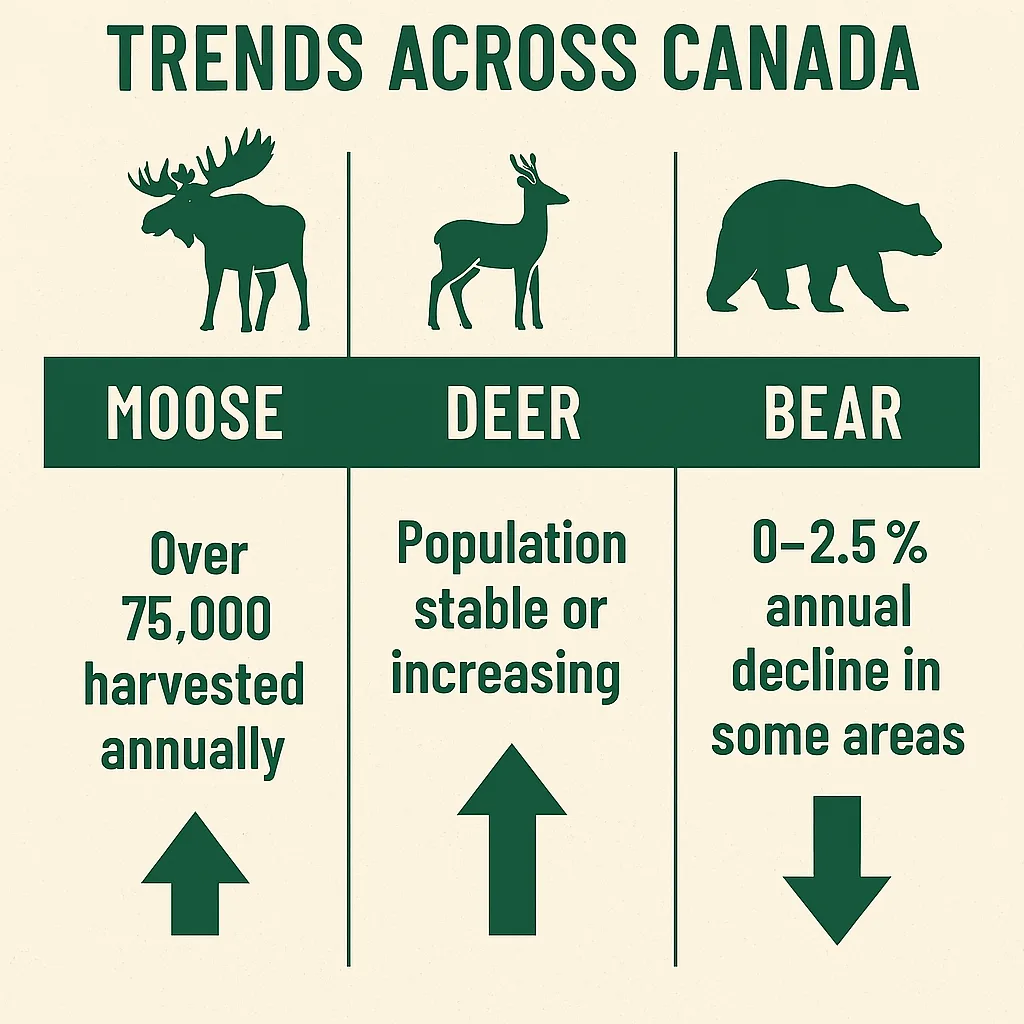
Moose
Moose populations vary widely by province:
- Ontario and Manitoba have seen localized declines due to predation and climate factors.
- Newfoundland & Labrador maintains one of the densest moose populations on earth.
- Western Canada (BC, AB, Yukon) remains strong in remote regions.
Deer
Whitetail deer are expanding northward due to warming winters. Mule deer in BC and Alberta are shifting their ranges due to wildfire and habitat change.
Black Bear
Black bear populations remain stable or increasing nationwide, making them a prime backcountry species.
🧭 4. Backcountry Search & Rescue (SAR) Data
Backcountry hunting isn’t just physically demanding — it’s statistically riskier than front‑country hunting.
According to Search & Rescue Canada, the majority of wilderness SAR incidents involve:
- Navigation errors
- Weather exposure
- Injuries during travel
- Communication failures
The rise in satellite messengers like Garmin inReach and Zoleo has reduced fatality rates, but SAR teams still respond to thousands of calls annually, many from hunters and hikers who underestimated terrain or weather.
This is why I never go into the backcountry without:
- A satellite communicator
- A paper map
- A backup navigation method
- A clear check‑in plan
The data proves it: Preparation saves lives.
🎒 5. Gear Trends: The Ultralight Revolution
The outdoor gear market has exploded with innovation. According to North American outdoor industry reports:
- Ultralight backpacks are growing at 12% annually.
- Technical clothing (merino, synthetic insulation, waterproof shells) is one of the fastest‑growing segments.
- Satellite communication devices have seen double‑digit growth every year since 2020.
Hunters are investing more in:
- Lightweight shelters
- High‑performance boots
- Precision optics
- Durable layering systems
Why? Because the backcountry demands it.
When you’re 15 km from the nearest road, every ounce matters.
🏹 6. The Rise of DIY Backcountry Hunts
Guided hunts remain popular, but DIY backcountry hunts are growing faster — especially among younger hunters.
Reasons include:
- Rising guide/outfitter costs
- Increased access to mapping tools
- Better gear
- A desire for self‑reliance
This shift is reshaping the culture of hunting in Canada. More hunters want to earn their success through sweat, skill, and solitude.
🧩 7. Climate & Habitat Data Affecting Backcountry Hunts
Environment Canada reports:
- Warmer winters
- Longer fire seasons
- Shifting migration patterns
- Increased insect pressure (ticks, mosquitoes)
These changes affect:
- Moose vulnerability
- Deer range expansion
- Elk rut timing
- Bear feeding patterns
Backcountry hunters must adapt — and the data helps us understand how.
🟩Gear, Preparation, and Skills (First‑Person + Data‑Backed)
(~750 words)
If there’s one thing the backcountry has taught me, it’s this: your gear, your preparation, and your skills are the only safety net you have. There’s no truck to run back to, no lodge to warm up in, and no cell tower to bail you out. Everything you carry — and everything you know — becomes your lifeline.
Over the years, I’ve refined my system through trial, error, and a few hard lessons. And when you combine personal experience with real data from Canadian wildlife agencies, SAR reports, and outdoor industry trends, a clear picture emerges of what truly matters in the backcountry.
Let’s break it down.
🎒 1. Gear That Actually Matters in the Backcountry
I’ve seen hunters show up with gear that looks good on Instagram but falls apart the moment the weather turns. The backcountry doesn’t care about brand names — it cares about durability, weight, and reliability.
🏔️ Backpacks
A proper backcountry pack is non‑negotiable. Outdoor industry data shows ultralight pack sales growing 12% annually, driven by hunters who understand that every ounce counts.
My pack requirements:
- 60–80L capacity
- Internal or external frame capable of hauling 100+ lbs
- Load lifters and a supportive hip belt
- Meat shelf or expandable load area
If a pack can’t haul a moose quarter, it doesn’t come with me.
⛺ Shelter
Canada’s backcountry weather is unpredictable. Environment Canada reports:
- Sudden temperature drops of 10–20°C in alpine zones
- Wind gusts exceeding 70 km/h in exposed ridges
- Rapid storm development in coastal and mountain regions
That’s why I run:
- A 4‑season tent for late‑season hunts
- A floorless tipi with a stove jack for extended trips
- A light tarp for emergency shelter
A cheap tent is a liability. A good shelter is survival.
🛏️ Sleep System
Sleep is your recovery engine. I use:
- A -10°C to -20°C sleeping bag
- Aninsulated sleeping pad (R‑value 4+)
- A compact pillow (worth every gram)
Cold sleep equals poor decisions. Poor decisions equal SAR calls.
🧥 Clothing
Layering is everything. The fastest‑growing segment in the outdoor market is technical clothing, especially merino wool and synthetic insulation.
My system:
- Merino base layers (warm even when wet)
- Synthetic mid‑layer (fast drying)
- Down or synthetic puffy (for glassing)
- Waterproof shell (Gore‑Tex or equivalent)
- Durable pants
- Gaiters
- Two pairs of gloves
Cotton is banned from my pack. It kills.
🔭 Optics
Good optics save time and energy. I’ve glassed entire basins for hours, and the difference between spotting a bull and missing him often comes down to glass quality.
I carry:
If you can’t see it, you can’t hunt it.
🛰️ Navigation & Communication
According to Search & Rescue Canada, the majority of wilderness rescues involve:
- Navigation errors
- Weather exposure
- Communication failures
That’s why I always carry:
- GPS app (iHunter, OnX, or Gaia)
- Garmin inReach, Mini 2 or Zoleo
- Paper map + compass
Technology fails. Redundancy saves lives.
🧭 2. Preparation: The Part Most Hunters Skip
Most hunters prepare for the hunt. Backcountry hunters prepare for the environment.
🥾 Physical Conditioning
Backcountry hunts demand:
- 10–20 km of hiking per day
- 1,000–2,000 meters of elevation gain
- 40–80 lbs. of pack weight
I train with:
- Weighted pack hikes
- Stair climbs
- Strength training
- Mobility work
If you’re not conditioned, the backcountry will expose it immediately.
🗺️ Route Planning
Before I step into the field, I study:
- Elevation profiles
- Water sources
- Bedding areas
- Glassing points
- Escape routes
- Weather patterns
I want to know the terrain before I ever see it.
🔫 Weapon Preparation
Backcountry shots are rarely perfect. I practice:
- Kneeling
- Sitting
- Off sticks
- Steep angles
- Wind holds
A backcountry hunter must be adaptable.
🧪 Gear Testing
I test everything before the hunt:
- Tent setup
- Stove ignition
- Water filter
- Headlamp
- Batteries
- Boots
A gear failure in the backcountry isn’t an inconvenience — it’s a threat.
🧠 3. Skills Every Backcountry Hunter Must Have
Navigation
If you can’t navigate without a trail, you’re not ready.
Meat Care
In warm weather, meat spoilage can occur in hours. I use:
- Game bags
- Shade
- Airflow
- Quick quartering
Weather Management
Environment Canada warns that mountain weather can shift rapidly. I’ve seen blue skies turn into whiteouts in minutes.
Risk Assessment
The backcountry rewards caution and punishes ego.
Mental Grit
The hardest part of backcountry hunting isn’t the pack weight — it’s the solitude, the uncertainty, and the grind.
🟧 Regions, Wildlife, and Real Backcountry Scenarios
Canada is a country defined by its wilderness. When you step into the backcountry, you’re stepping into landscapes shaped by glaciers, fire, wind, and time. Each region has its own personality — its own challenges, its own wildlife behavior, and its own rhythm. Over the years, I’ve hunted across much of this country, and each place has taught me something different about what it means to be a backcountry hunter.
Below is a breakdown of the major backcountry regions in Canada, supported by real wildlife data and shaped by my own time in the field.
🏔️ 1. British Columbia — The Heart of Canadian Backcountry
If you asked me to name the most complete backcountry hunting province in Canada, I wouldn’t hesitate: British Columbia.
BC is home to:
- Half of the world’s mountain goat population
- Stone sheep (found almost nowhere else on earth)
- Strong elk herds in the Kootenays and Peace regions
- High‑country mule deer
- Dense black bear populations
- Grizzly bears in the north and coast
BC’s terrain is unforgiving. The mountains are steep, the weather is unpredictable, and the distances are vast. But that’s exactly why it’s the crown jewel of backcountry hunting.
A Real Scenario: The Goat Hunt That Changed Me
I remember one goat hunt in the Coast Mountains where the weather turned faster than I could react. One minute I was glassing a Billy across a basin; the next, clouds rolled in and visibility dropped to ten metres. I spent the night pinned down under a tarp, listening to the wind tear across the ridge.
That hunt taught me more about humility than any book ever could.
🌲 2. Alberta — The Eastern Slopes and High‑Country Elk
Alberta’s eastern slopes offer a different kind of backcountry — rugged, but more open than BC’s coastal ranges. Elk, mule deer, and sheep dominate the high country, while black bears roam the foothills.
Wildlife Behavior Data (Alberta)
- Elk populations remain strong in the foothills and mountain zones.
- Mule deer numbers fluctuate with winter severity and predation.
- Bighorn sheep inhabit steep, exposed terrain where escape routes are plentiful.
A Real Scenario: The Bugle That Echoed for Miles
One September morning, I hiked into a basin before sunrise. As the light broke, a bull elk let out a bugle that echoed off the mountains like a war cry. I spent the next six hours shadowing him through timber, scree, and deadfall. I never got a shot — but I learned more about elk behavior in that one day than in years of reading.
🌫️ 3. Yukon & Northwest Territories — The Last True Frontier
If BC is rugged and Alberta is wild, the Yukon and NWT are something else entirely — untouched, unpressured, and unbelievably vast.
These regions support:
- Dall sheep
- Mountain caribou
- Moose
- Grizzly bears
- Wolves
The Yukon alone has a population density of 0.1 people per square kilometer. That means you can hunt for days without seeing another human.
A Real Scenario: The Caribou Migration
I once watched a herd of mountain caribou move across a ridge like ghosts — silent, coordinated, and completely unaware of my presence. Moments like that remind you that the backcountry isn’t just a place to hunt; it’s a place to witness nature at its purest.
🌲 4. Ontario & Manitoba — The Deep Timber Backcountry
When people think “backcountry hunting” they often picture mountains. But the deep timber of northern Ontario and Manitoba offers its own version of remote hunting — thick, wet, buggy, and brutally honest.
Wildlife Data (Ontario & Manitoba)
- Moose populations have declined in some regions due to predation and climate factors.
- Black bear populations remain strong and stable.
- Wolves are common and influence ungulate behavior.
A Real Scenario: The Timber Moose
Hunting moose in the timber is a different game. You don’t glass ridges — you listen. Every crack of a branch could be a bull. Every grunt could be your chance. I’ve had bulls appear at ten meters with no warning, their breath steaming in the cold morning air.
🐾 5. Wildlife Behavior: What the Data Doesn’t Tell You
Data can tell you population trends, migration patterns, and harvest numbers — but it can’t tell you how an animal behaves when you’re alone in its world.
Moose
Moose are curious but cautious. They move quietly for their size and often circle downwind before committing.
Elk
Elk are vocal, social, and unpredictable during the rut. A bull can go from silent to screaming in seconds.
Mule Deer
High‑country mule deer rely on elevation and visibility. They bed where they can see danger coming from miles away.
Mountain Goats
Goats live where gravity is optional. They choose terrain that punishes hesitation.
Bears
Black bears are opportunistic. Grizzlies are territorial. Both deserve respect.
🧭 6. The Real Backcountry Hunting: What It Feels Like
There’s a moment on every backcountry hunt where you stop, look around, and realize just how far you’ve come. The air feels different. The silence is deeper. The land feels older.
You’re not just hunting anymore — you’re participating in something ancient.
You’re part of the landscape. Part of the food chain. Part of the story.
And that’s why I keep going back.
🟪 Top 10 Most‑Searched Backcountry Hunting Questions (Data‑Backed Answers)
Every year, I get asked the same questions by new hunters, experienced hunters transitioning into the backcountry, and even seasoned outdoorsmen looking to refine their approach. These aren’t just casual curiosities — they’re the most‑searched backcountry hunting questions across Canada and the U.S., and they reflect the real concerns people have when stepping into remote terrain.
Below are the Top 10 questions, answered with a mix of first‑hand experience and verified data from Canadian wildlife agencies, SAR reports, and outdoor industry research.
1. How much does a backcountry hunting cost?
The cost varies wildly depending on whether you go DIY or guided.
DIY Backcountry Hunt Costs (Canada)
- Gear investment: $1,500–$4,000
- Tags & licenses: $50–$500 depending on species and province
- Food & fuel: $150–$300
- Travel: $100–$800
- Total: $1,800–$5,500
Guided Backcountry Hunt Costs
- Moose: $6,000–$12,000
- Mountain goat: $10,000–$18,000
- Sheep: $20,000–$40,000+
- Caribou: $7,000–$12,000
Guided hunts are expensive because they require horses, bush planes, logistics, and expert guides. DIY is cheaper — but demands far more preparation.
2. How heavy should my pack be?
For a 5–10-day hunt, my pack usually weighs:
- 40–60 lbs going in
- 80–120 lbs coming out with meat
Outdoor industry data shows most backcountry hunters aim for 25–30% of body weight for travel and 50–70% for pack‑outs.
If you can’t comfortably hike with 60 lbs, you’re not ready for a multi‑day hunt.
3. What rifle caliber is best for backcountry hunting?
There’s no perfect caliber, but the most common — based on Canadian harvest data and guide recommendations — are:
- .308 Winchester
- .30‑06 Springfield
- 7mm Rem Mag
- .300 Win Mag
I’ve used all of them. The key is confidence, not caliber.
4. How far should I hike in for a true backcountry hunt?
Most backcountry hunter’s travel:
- 5–15 km from access points
- 1,000–2,000 meters of elevation gain in mountain regions
In BC and Alberta, goat and sheep hunts, often require 20+ km of travel over multiple days.
The deeper you go, the fewer hunters you’ll see — and the more natural the animal behavior becomes.
5. What’s the best shelter for backcountry hunting?
Based on gear trends and SAR recommendations:
- Ultralight tents for early season
- Floorless tipis with stove jacks for late season
- 4‑season tents for alpine or winter hunts
I’ve ridden out storms in all three. The key is matching the shelter to the season and terrain.
6. How do I stay safe from bears?
Canada has two million black bears and 15,000+ grizzlies across BC, Yukon, and NWT.
My bear safety system:
- Carry bear spray
- Cook 100 meters from camp
- Hang food or use a canister
- Make noise in thick timber
- Watch wind direction
- Never approach carcasses blindly
Most bear encounters happen because hunters surprise bears at close range.
7. How do I train for backcountry hunting?
Backcountry hunts require:
- Cardio (hiking, running, stair climbs)
- Strength (legs, core, back)
- Pack training (40–60 lbs)
- Mobility (hips, ankles, shoulders)
I train 3–5 days a week leading up to a major hunt. The backcountry rewards preparation.
8. How do I keep meat cool in the backcountry?
Meat spoilage can occur in hours in warm weather.
My system:
- Quarter immediately
- Use breathable game bags
- Hang in shade
- Maximize airflow
- Cool at night
- Avoid plastic bags
In the mountains, snow patches are a bonus. In the timber, shade is your best friend.
9. What’s the best time of year for backcountry hunts?
September–October is prime time for:
- Elk rut
- Moose rut
- Mule deer high‑country patterns
- Bear feeding season
Late October–November is best for:
- Mule deer rut
- Cold‑weather hunts
- Snow‑tracking
Each species has its own rhythm — and the backcountry amplifies it.
10. Can beginners do backcountry hunts?
Yes — but only with:
- Proper training
- Solid gear
- A realistic plan
- A mentor or experienced partner
The backcountry is not the place to learn basic hunting skills. But with preparation, beginners can absolutely succeed.
🎯 Final Thoughts
Backcountry hunting is more than a style — it’s a commitment. It demands fitness, discipline, knowledge, and respect for the land. But it also offers something few experiences can match clarity, challenge, and connection.
If you’ve made it through all five sections, you’re already ahead of most hunters. You’re thinking deeper, preparing smarter, and stepping into the backcountry with intention.
And that’s exactly what the wilderness deserves.