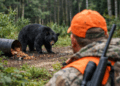
Everything Ontario hunters actually need — original field advice on WMU selection, tag strategy, bait setup, shot selection, and staying onside with MNRF regulations. No filler, no recycled information.

There is a moment that every person who has spent time doing bear hunting Ontario knows well. You have been sitting on stand for two hours. Black-flies circle despite the cooling air. Then, the timber goes quiet in a specific way — not the absence of sound, but a deliberate stillness that feels like the bush holding its breath. Then the bait barrel shifts. This is Ontario bear hunting in a nutshell: patience rewarded by one of the most electric encounters in North American hunting.
📋 In This Guide
- What Makes Ontario’s Bear Country Unique
- Reading the 2025 Season Calendar
- Getting Your Tag: Residents vs. Non-Residents
- Choosing the Right WMU for Your Hunt
- Setting a Bait Station That Actually Works
- Shot Placement & Calibre Selection
- Field Care: Getting Bear Meat Home Clean
- The Regulations That Trip Hunters Up Most
- Frequently Asked Questions
What Makes Ontario’s Bear Country Unique
Ask any experienced guide who has worked multiple Canadian provinces, and they will tell you the same thing: the boreal corridor running from Sudbury northwest to the Manitoba border produces bears that are simply different. Bear hunting Ontario in this region means contending with animals that have grown up on a diet of blueberries, hazelnuts, and wild cherries packed into a short summer season. The result is a bear that enters fall in exceptional body condition. By September, they move with a purposeful hunger that makes them far more readable than bears in pressured southern landscapes.
Ontario’s geography gives hunters a rare combination: enormous tracts of Crown Land with no trespass complications, a licensing system that keeps harvest in balance with population, and enough variation in terrain—Shield rock, river delta, boreal peat, hardwood transition—allowing hunters to choose a setting that matches both their skill level and preferred method. Bear hunting Ontario is not a single experience; it offers a dozen different hunts depending entirely on where you go and how you approach it.
📊
By the Numbers
Ontario’s black bear population sits in the range of 85,000 to 105,000 animals according to MNRF population modelling. The province issues roughly 7,000 to 9,000 tags annually. This sustainable harvest keeps population numbers stable year over year.
The biggest misconception new hunters bring to bear hunting Ontario is the assumption that a high population automatically means easy hunting. It does not. Dense forests, limited sight lines, and bears that approach bait stations almost exclusively after legal shooting light make consistent success a genuine skill. The province rewards hunters who do their homework and punishes those who treat a bait barrel as a guarantee.
Anyone who tells you that bear hunting in Ontario is just sitting and waiting has never hunted a true mature boar. Those animals write their own schedule, and your job is to figure it out before your week runs out.
Reading the 2026 Season Calendar – Bear Hunting Ontario
Ontario splits its bear hunting Ontario opportunity across two seasons, and understanding the behavioural differences between them is what separates hunters who fill their tags from those who come home empty.
The Spring Season
Spring bear hunting runs from mid-April through mid-June in most Wildlife Management Units, though exact open dates shift by zone. Bears emerging from dens in spring are lean, sometimes dramatically so, and their primary biological imperative is caloric recovery. This makes them highly susceptible to a well-managed bait site. A barrel loaded with the right attractants in a location that offers both food and a sense of security is almost irresistible to a hungry spring bear. The downside is that shot opportunities can be complicated by foliage that has not yet leafed out, by bears arriving at poor light, and by the challenge of identifying sows with cubs at distance.
The Fall Season
The fall bear hunting Ontario season typically opens September 1 and runs through late October or November depending on the WMU. Fall bears are in hyperphagia — a biologically driven eating frenzy that precedes denning — and they move more predictably during daylight hours than at any other point in the year. A bear taken in October from the right zone will frequently exceed 350 pounds and can push 500 pounds in areas with exceptional natural food years. The fat on a fall bear is substantial, the coat is at its finest, and the meat is typically at its best.
| Season | Typical Open | Typical Close | Bear Condition | Best Method |
|---|---|---|---|---|
| Spring | Mid-April (WMU varies) | ~June 15 | Lean, motivated, unpredictable at bait | Bait station |
| Fall | September 1 | Oct 31 – Nov 30 (WMU varies) | Heavy, fat, daylight movement during hyperphagia | Bait or natural food source |
| Resident-Only WMUs | Per zone regulation | Per zone regulation | Varies by geography | All legal methods |
⚠️
Check Before You Go
Quota WMUs can close mid-season without advance notice once the bear harvest ceiling is reached. Before every single hunt day in a quota zone, verify current status through the MNRF’s online quota tracker at ontario.ca/hunting. This is not optional — hunting a closed zone carries serious consequences.
Getting Your Tag: Residents vs. Non-Residents – Bear Hunting Ontario
Securing the right documentation before you head into the bush is the unglamorous foundation of any successful bear hunting Ontario trip. Here is what each category of hunter needs:
Ontario Resident Hunters
- A current Ontario Outdoors Card paired with a valid Hunting Licence
- One bear tag, available over the counter at most ServiceOntario locations and online — no draw required in open WMUs
- Proof of hunter education if you were born after December 31, 1972
- One bear per licence year — tags are non-transferable
- Bait station registration (separate process) if you plan to run your own bait
Non-Resident Hunters
- A non-resident Hunting Licence (fee changes annually — always verify at ServiceOntario)
- A bear tag at the non-resident rate
- In most designated WMUs, mandatory accompaniment by a licensed Ontario Registered Outfitter (ORO)
- U.S. hunters should confirm their home state’s rules around importing black bear prior to travel — while CITES certification is not required for black bear specifically, certain states impose their own import restrictions
💡
Early Bird Wins
Over-the-counter tags for peak Northwestern Ontario WMUs move quickly when they become available at the start of the calendar year. If bear hunting Ontario in a specific high-demand zone is your plan, purchase your tag the moment the new year’s tags go live — not in March when you start thinking about the spring season.
Choosing the Right WMU for Your Hunt – Bear Hunting Ontario
Ontario’s more than 90 Wildlife Management Units vary enormously in bear density, terrain, access, and the hunting pressure they see each year. Picking the right one for your specific situation is often more important than any tactical decision you make in the field. Here is how to think through it:
Northwestern Ontario — The Trophy Benchmark
WMUs in the Kenora, Red Lake, Ear Falls, and Sioux Lookout areas consistently produce the largest-bodied bears in the province. The combination of remote boreal habitat, abundant berry crops, and relatively low hunting pressure per square kilometre allows bears to grow older and heavier than in more accessible zones. Bear hunting Ontario in the northwest is the closest thing to a guaranteed opportunity at a mature boar, though the logistics — fly-in access, remote camps, significant travel — raise both cost and planning complexity.
Algoma and the North Shore — Road-Accessible Trophy Country
The WMUs running along the north shore of Lake Superior, particularly around Wawa and White River, offer a compelling middle ground: genuine trophy potential in bears that feed on the rich mixed forest transition zone, with road-accessible outfitter camps that keep costs lower than fly-in operations. This is some of the most productive country for first-time guided bear hunting Ontario experiences.
Near-North Zones — The Self-Guided Option
WMUs in the Sudbury, Parry Sound, and Chapleau areas are more accessible by vehicle and see somewhat higher hunting pressure, but they still hold good numbers of bears and offer a realistic self-guided option for Ontario residents who want to run their own bait station on Crown Land without booking an outfitter. Bears here may average smaller than the far northwest, but a mature boar from Chapleau country is still a serious animal.
| Region | Trophy Size | Access | Best Fit For |
|---|---|---|---|
| NW Ontario — Kenora / Red Lake | ⭐⭐⭐⭐⭐ Exceptional | Fly-in or remote road | Non-residents, serious trophy hunters |
| Algoma — Wawa / White River | ⭐⭐⭐⭐ Very Good | Road-accessible | First-time guided hunters |
| Near-North — Sudbury / Chapleau | ⭐⭐⭐ Good | Highway & forestry road | Self-guided residents |
| NE Ontario — Cochrane / Kapuskasing | ⭐⭐⭐⭐ Very Good | Mixed — some remote | Fall hunters; excellent meat quality |
Advertisement — 728×90 Mid-Article
Setting a Bait Station That Actually Works – Bear Hunting Ontario
The mechanics of registering a bait station for bear hunting Ontario are straightforward — the MNRF registration process takes minutes. The art of building a site that consistently draws mature bears before dark is considerably more involved.
Location Logic
The most common mistake hunters make when siting a bait station is choosing a location based on their own convenience rather than bear behaviour. A barrel placed where you can easily access it from a road will often have bears visiting it at 2 a.m. — not at 6 p.m. Look for locations with natural features that give bears a sense of security approaching the bait: a ridge-line that allows approach with the wind, a thick spruce thicket nearby, a travel corridor between two habitat types. The bear needs to feel safe arriving while it is still light enough for you to shoot.
Attractant Selection
Bears navigate primarily by nose, and your attractant choice matters far more than the physical bait itself. Anise oil — the same compound that gives black licorice its flavour — carries enormous distances in cool spring air and has an almost universal appeal to Ontario black bears. Combine it with a high-calorie food source (rendered fryer oil from a restaurant, pastries, unsalted nuts) and you create a scent column that can pull bears from a kilometre away on the right wind. Change up the food component regularly — a bear that has been hitting the same barrel for two weeks may begin to approach with more caution if nothing changes.
Legal Requirements at a Glance
- Register your bait station through the MNRF before placing any bait
- One registered station per licensed hunter — stations cannot be shared between licence holders
- Minimum 200 metres from any building, paved road, or water body
- Container must display your name, address, and licence number on a weatherproof tag
- All bait and containers must be removed within a defined period after your season closes — failure to do so is a ticket-able offence
🎯
Field Insight – Bear Hunting in Ontario
Put a cellular trail camera on your bait station two to three weeks before your hunt begins. Review photos daily. A mature boar visiting consistently at 8:30 p.m. in the first week will often shift that arrival 20 to 30 minutes earlier as he becomes more comfortable with the site. By hunt week, he may be arriving in the last legal shooting hour. That camera data tells you exactly when to be on stand — and when not to be, to avoid bumping him early in the season.
Shot Placement & Calibre Selection – Bear Hunting Ontario
More bears are wounded and lost during bear hunting Ontario season than most hunters realize, and the cause is almost always the same: underestimating how differently a bear’s vitals are positioned compared to deer. A bear standing quartering-toward presents a deceptively small target window. Its thick skull, heavy shoulder bones, and dense layers of fat can deflect or absorb shots that would anchor a whitetail.
Where to Aim
On a broadside bear, aim directly behind the front leg at one-third the body depth from the bottom of the chest — not the centre of the body mass. Bear vitals sit low and forward. A shot that looks centred on the body from a tree-stand often sails through stomach. The goal is double-lung penetration, ideally clipping the top of the heart. When a bear is quartering away, drive the bullet toward the off-shoulder. For bow-hunters: let the bear step forward with the near front leg before releasing — this opens the chest cavity.
Minimum Recommended Calibres for Ontario Bear Hunting
- Centre-fire Rifle: .30-06 Springfield or larger — the .30-06 with a 180-grain bonded bullet remains a gold standard for bear hunting Ontario at bait-station distances. The .308 Win, .300 Win Mag, .35 Whelen, and .338 Win Mag are all excellent choices.
- Shotgun: 12-gauge with rifled slugs at ranges under 75 metres — effective for thick bush situations
- Archery: Minimum 60-pound draw weight with a fixed-blade broad-head. Mechanical broad-heads can fail on the dense shoulder bone of a mature boar. Keep shots inside 30 metres at bait.
- Muzzle loader: Permitted where open firearm season applies — .50 calibre with a conical bullet and 100-grain equivalent powder charge minimum
Field Care: Getting Bear Meat Home Clean
Food safety is non-negotiable when it comes to bear meat. Bear meat must reach 160°F (71°C) internal temperature during cooking. Unlike pork, freezing does not eliminate Trichinella in bear muscle tissue. Always use a meat thermometer for bear preparations, including smoked, slow-cooked, and ground bear.
Beyond food safety, the single biggest factor in bear meat quality is how quickly you cool the carcass after the shot. A bear’s dense fat layer retains heat aggressively. In September temperatures, a bear that is not skinned and quartered within two hours of expiration will begin to sour from the inside out. Have your game bags, bone saw, and a cooler pre-loaded with block ice ready before you shoot.
Ontario black bear meat is exceptional table fare when handled correctly in the field. However, it becomes a serious health risk when not handled properly. This is not an exaggeration—bears can carry Trichinella spiralis, a parasitic roundworm that survives in under-cooked muscle tissue, causing trichinellosis in humans. Every piece of bear meat you eat must be cooked to a minimum internal temperature of 160°F (71°C). Freezing alone does not reliably kill Trichinella in bear, unlike with pork.
Food Safety — Non-Negotiable
Bear meat must reach 160°F (71°C) internal temperature during cooking. Unlike pork, freezing does not eliminate Trichinella in bear muscle tissue. Use a meat thermometer every time — this applies to smoked, slow-cooked, and ground bear preparations as well.
The Regulations That Trip Hunters Up Most – Bear Hunting Ontario
Both experienced and first-time hunters alike make compliance errors during bear hunting Ontario season. The following are the rules that generate the most Conservation Officer encounters:
| Rule | What It Requires | Common Mistake |
|---|---|---|
| Sow & Cub Identification | Do not shoot a sow with cubs or a cub of the year under any circumstance | Shooting before the animal is fully out of cover and positively identified as a mature bear without accompanying cubs |
| Immediate Tagging | Attach your bear tag the moment the animal expires — not when you return to camp | Leaving the tag in a pack and moving the animal before attaching it |
| Meat Salvage | Edible meat must be reasonably retrieved from the field — abandoning quarters is a wanton waste offence | Taking only the hide and skull from a remote kill and leaving the meat |
| Quota Zone Tracking | Hunters must verify their WMU is still open before hunting each day once a quota zone is active | Assuming the zone is open because it was open the day before |
| Gallbladder Export | Bear gallbladder cannot be exported from Ontario — it must remain in the province | Attempting to transport a whole carcass across the border without removing the gallbladder |
| Bait Station Removal | All bait and containers must be removed within the regulated period following season close | Leaving barrels in the bush until next spring — this is an offence and harms Crown Land for other users |
Frequently Asked Questions About Bear Hunting Ontario
Is Ontario a good province for a first-time bear hunter?
Ontario is genuinely one of the best places in North America to begin bear hunting Ontario for the first time. The combination of a strong outfitter network, over-the-counter tags in most zones, accessible public land, and a healthy bear population means first-timers have a realistic shot at success without needing connections or years of scouting experience. Booking a guided hunt in the Algoma or Wawa region for a spring bait hunt is a particularly strong starting point. Can I hunt bear on public Crown Land in Ontario without an outfitter?
Can I hunt bear on public Crown Land in Ontario without an outfitter?
Ontario residents can absolutely self-guide on Crown Land for bear hunting Ontario. You will need to register a bait station through the MNRF, secure your tag, and comply with all placement and removal regulations. Non-residents face a different situation — most WMUs that non-residents can hunt require them to be accompanied by a licensed Ontario Registered Outfitter. Check the specific WMU designation before planning a self-guided non-resident hunt. What is the best natural food to look for when scouting bear in fall?
What is the best natural food to look for when scouting bear in fall?
In fall, Ontario bears prioritize high-calorie food sources as they build their winter fat reserve. Wild blueberries, hawthorn berries, hazelnuts, mountain ash berries, and acorns (in the southern transition zones) are the primary attractants. A clear-cut that is four to eight years old, covered in berry growth and bordered by mature forest, is one of the best natural spots to still-hunt or glass for fall bears during bear hunting Ontario season. How do I tell if a bear at my bait station is a sow with cubs?
How do I tell if a bear at my bait station is a sow with cubs?
The key skill in bear hunting in Ontario is to wait until the bear is fully out of cover before making a decision. Cubs, which are about the size of a large house cat in spring and weigh 15–20 lbs by fall, often make noise, so listen for mewing or chirping sounds. If a bear looks back toward the tree line, it’s likely a sow watching her cubs, so hold off on shooting. The penalties for mistakenly killing a sow with cubs are significant, with a high prosecution rate.
Do I need bear spray on an Ontario bear hunting trip?
Yes, always. Even when doing bear hunting Ontario with a firearm, bear spray is a valuable backup for close-range encounters that do not allow time to raise and aim. This is especially relevant when retrieving a downed bear in thick cover, when checking bait stations unarmed, or when moving through the bush at dawn and dusk. Carry a minimum 225-gram canister in an accessible holster — not buried in a pack. What happens if a quota WMU closes while I am already at camp?
What happens if a quota WMU closes while I am already at camp?
If the MNRF closes a quota WMU mid-season and you are already on site with a tag but have not yet harvested a bear, your hunt in that specific WMU is over for the season regardless of how many days remain in your booking. Your tag may potentially be valid in an adjacent open WMU, but you would need to confirm that with the MNRF directly. This is why daily quota verification matters during bear hunting Ontario in active quota zones — being the hunter who shoots on a closed day is not a position you want to be in.
Making the Most of Your Ontario Bear Hunt
The hunters who consistently do well in bear hunting Ontario year after year share one characteristic: they treat preparation as part of the hunt, not just the logistics before it. Understanding the specific WMU, building a bait strategy that accounts for bear behaviour rather than hunter convenience, spending time on shot placement practice before the season, and knowing the regulations well enough to catch yourself before making an error — these habits pay off in Ontario bear country in ways they do not in easier hunting environments.
Ontario asks more of bear hunters than many jurisdictions, and the bears themselves can humble the overconfident. But when it comes together—when that mature boar steps into the evening light and you have done everything right—there is no hunting experience in Canada quite like it. Bear hunting Ontario is worth doing, worth doing properly, and worth coming back for.
Hunt safe, respect the resource, and leave the bush cleaner than you found it.
Bear hunting in Ontario asks more of hunters than many jurisdictions, and the bears themselves can humble the overconfident. But when it comes together—when that mature boar steps into the evening light and you have done everything right—there is no hunting experience in Canada quite like it. Bear hunting Ontario is worth doing, worth doing properly, and worth coming back for.Manitoba Hunting Regulations2026 Manitoba Hunting RegulationsManitoba Hunting Regulations2026 Ontario Hunting Regulations2026 Manitoba Hunting RegulationsManitoba Hunting RegulationsOntario HuntingHunting SeasonBackcountry HuntingCanada Backcountry HuntingQuebec fishing regulations 2025Moose Hunting Campshunting campswildernessBackcountry Huntingmoose huntingCanada Backcountry Huntinghunting regulationsHunting Regulations2026 Manitoba Hunting Regulations