🏔️ Introduction: The Backbone of Northern Big‑Game Culture
Across the northern wilderness of North America, moose hunting camps stand as one of the last remaining symbols of true backcountry tradition. These camps aren’t just temporary shelters — they are operational hubs, cultural touchstones, and the foundation of a hunting lifestyle that has shaped generations of northern families, outfitters, and conservationists.
From the remote river systems of Alaska to the dense boreal forests of Canada, moose hunting camps serve as the staging ground for one of the most physically demanding and culturally significant hunts on the continent. They are where strategy is built, where meat is processed, where weather is endured, and where stories are passed down like heirlooms.
But to understand the importance of moose hunting camps, you must first understand the animal that defines them. Before heading into true northern wilderness, hunters should review Parks Canada’s official backcountry guidelines.
🦌 North American Moose Population Overview
Moose (Alces alces) are the largest members of the deer family, and their distribution across North America is heavily tied to the ecosystems that support them — boreal forest, subarctic tundra, and riparian zones.
While population numbers fluctuate due to predation, climate, disease, and habitat change, moose remain a cornerstone species for both ecological balance and northern hunting culture.
Below is a consolidated, high‑authority snapshot of moose populations across Alaska and Canada, based on wildlife agency data, conservation reports, and population monitoring summaries.
📊 Table 1: North American Moose Population Estimates (Alaska + Canada)
| Region | Estimated Moose Population | Notes |
|---|---|---|
| Alaska (USA) | ~175,000–200,000 | One of the strongest moose populations in the world; highly regulated management. |
| Yukon (Canada) | ~70,000 | Extremely high density relative to human population; prime wilderness habitat. |
| British Columbia (Canada) | ~120,000–170,000 | Populations vary by region; some declines due to predators & climate. |
| Alberta (Canada) | ~118,000 | Stable to increasing in many zones; strong management programs. |
| Saskatchewan (Canada) | ~45,000–50,000 | Expanding range; strong boreal habitat. |
| Manitoba (Canada) | ~25,000–30,000 | Local declines in southern zones; stable in northern boreal regions. |
| Ontario (Canada) | ~80,000–90,000 | One of Canada’s largest populations; heavily monitored. |
| Quebec (Canada) | ~120,000 | Strong eastern population; varied terrain. |
| Newfoundland & Labrador (Canada) | ~120,000 | Highest moose density per square mile in North America. |
🧭 Why These Numbers Matter for Moose Hunting Camps
Moose population density directly influences:
1. Camp Location Strategy
High‑density regions (e.g., Newfoundland, Yukon, Interior Alaska) allow for more flexible camp placement, while lower‑density regions require strategic positioning near migration corridors, burns, or river systems.
2. Camp Type Selection
- Alaska: Boat‑based or fly‑in camps dominate due to vast, roadless terrain.
- Canada: Wall tents, cabin camps, and ATV‑accessible camps are more common.
3. Hunt Duration & Logistics
Lower‑density regions often require longer hunts, more glassing, and more mobile spike camps.
4. Conservation & Tag Allocation
Regions with declining populations enforce stricter tag systems, influencing camp planning and hunter distribution.
🌲 Moose Population Trends: What the Data Shows
Alaska
Moose populations remain strong across most Game Management Units (GMUs), with some areas showing growth due to predator control and habitat improvement.
Canada
Population trends vary by province:
- Increasing: Alberta, Saskatchewan
- Stable: Yukon, Quebec
- Declining in some zones: British Columbia, Manitoba, Ontario (southern regions)
These fluctuations influence everything from camp placement to harvest expectations.
🔍 How This Data Shapes the Rest of the Article
The population data above sets the foundation for:
- Habitat distribution (Part 2)
- Harvest success rates (Part 3)
- Camp types and logistics (Part 4)
- Conservation and economic impact (Part 5)
Each section will build on this baseline to create the most comprehensive, authoritative guide to Moose Hunting Camps available online.
🌎 Understanding Moose Habitat: The Foundation of Every Moose Hunting Camps
To build or choose the right moose hunting camp, you must first understand the land itself. Moose are not generalists — they are deeply tied to specific ecosystems that provide the food, cover, and water they need to survive. Across North America, their distribution is shaped by climate, vegetation, predator density, and human access.
Whether you’re hunting the river bottoms of Alaska or the dense boreal forests of Canada, the habitat dictates everything:
- Where camps can be placed
- How hunters travel
- How bulls move during the rut
- Where cows calve
- How predators influence behavior
- How weather impacts visibility and mobility
This section breaks down the major habitat zones, terrain types, and distribution patterns that define moose hunting across the continent.
🏞️ Moose Habitat Zones Across North America
Moose occupy one of the largest continuous wildlife ranges on the continent, stretching from Alaska across the Canadian north and into parts of the northern United States. Their habitat can be divided into four major zones:
1. Boreal Forest (Canada + Interior Alaska)
This is the core of North America’s moose population.
Key Characteristics
- Dominated by black spruce, jack pine, birch, and poplar
- Thick understory of willow, alder, and dogwood
- Countless lakes, rivers, and wetlands
- Long winters, short summers
Why It Matters for Camps
- Dense cover means moose are often close, but visibility is limited
- Camps must be placed near natural openings, burns, or river systems
- ATV and boat access is common; fly‑in camps dominate remote regions
2. Subarctic Tundra (Alaska + Yukon)
This is where some of the largest bulls in the world roam.
Key Characteristics
- Open tundra mixed with willow flats
- River corridors act as migration highways
- Extreme weather swings
- Sparse tree cover
Why It Matters for Camps
- Camps must be wind‑protected
- Spot‑and‑stalk hunting is more effective
- Boat‑based camps are common along major rivers
- Long pack‑outs are the norm
3. Mountainous Regions (British Columbia, Yukon, Alaska Range)
Moose thrive in high‑elevation basins and valley bottoms.
Key Characteristics
- Steep terrain
- Alpine meadows
- Dense timber pockets
- Heavy snowfall
Why It Matters for Camps
- Camps must be placed strategically to avoid avalanche paths
- Horses, packrafts, or fly‑in access often required
- Bulls move vertically with weather and rut timing
4. Maritime & Island Ecosystems (Newfoundland & Labrador)
Home to the highest moose density per square mile in North America.
Key Characteristics
- Boggy terrain
- Thick tuckamore (stunted spruce)
- High rainfall
- Abundant forage
Why It Matters for Camps
- Camps must be built on elevated, well‑drained ground
- Mobility is limited — hunters often rely on foot access
- Bulls respond aggressively to calling due to high competition
📊 Table 2: Moose Habitat Zones (Alaska vs. Canada)
| Habitat Type | Alaska | Canada | Notes |
|---|---|---|---|
| Boreal Forest | Yes (Interior) | Yes (Majority of provinces) | Core habitat for most moose populations. |
| Subarctic Tundra | Extensive | Limited (Yukon/NWT) | Produces some of the largest bulls. |
| Mountainous Terrain | Alaska Range | BC, Yukon | Requires specialized camp setups. |
| Maritime/Island | Limited | Newfoundland & Labrador | Highest moose density in North America. |
🧭 Moose Distribution Patterns: How Bulls Move Across the Landscape
Understanding how moose move is essential for choosing the right camp location.
1. Seasonal Movement
Moose shift habitat based on:
- Rut timing
- Snow depth
- Predator pressure
- Food availability
2. Rut Behavior
During the rut (late September to mid‑October), bulls:
- Travel long distances
- Seek cows in willow flats and river bottoms
- Respond aggressively to calling
- Move into more open terrain
The Alaska Department of Fish & Game offers extensive research on moose behavior and rut activity.
3. Wintering Areas
Moose winter in:
- Dense conifer stands
- Low‑elevation valleys
- Areas with reduced snow depth
4. Calving Grounds
Cows calve in:
- Remote wetlands
- Islands
- Thick willow stands
- Predator‑protected zones
These patterns influence where camps should be placed for maximum success. More detailed information on moose habitat and population science is available through Environment and Climate Change Canada.
🌡️ Climate & Weather: The Silent Architect of Moose Hunting Camps
Moose are highly sensitive to temperature. Warm weather reduces movement dramatically, especially for bulls in September.
Temperature Effects
- Above 10°C (50°F): Moose movement drops sharply
- Below freezing: Bulls move aggressively during the rut
- Heavy rain: Moose bed down in timber
- Wind: Bulls seek sheltered basins
Camp Implications
- Camps must be placed near shaded, cool areas
- Access to water is essential
- Wind‑protected sites reduce heat loss and tent damage
🛶 Terrain & Access: How Geography Shapes Camp Strategy
Alaska
- River systems dominate access
- Boat‑based camps allow mobility
- Tundra requires elevated, dry camp platforms
- Fly‑in camps are common due to roadless terrain
Canada
- ATV trails, logging roads, and lakes provide access
- Wall tents and cabin camps are more common
- Boreal forest requires careful camp placement to avoid bogs
🔍 Why Habitat Knowledge Is Essential for Moose Hunting Camps
Understanding habitat is the difference between a camp that produces bulls and a camp that produces frustration.
Habitat knowledge determines:
- Where to place your camp
- How far you’ll need to travel
- What gear you need
- How bulls will respond to calling
- How weather will impact movement
- How long your hunt will take
This is why the best outfitters, guides, and DIY hunters spend more time studying habitat than anything else.
🎯 Why Harvest Success Rates Matter for Moose Hunting Camps
Moose hunting is one of the most logistically demanding big‑game pursuits in North America. Unlike deer or elk, moose require:
- Larger hunting areas
- Longer travel distances
- More specialized gear
- More physical effort
- More time in camp
Because of this, harvest success rates are one of the most important indicators of:
- Where to place a moose hunting camp
- How long a hunt should be
- What type of camp setup is required
- How many hunters an area can support
- How much pressure the region can sustain
Understanding harvest success rates is essential for both outfitters and DIY hunters. It determines expectations, influences strategy, and shapes the entire structure of a moose hunting camp.
🦌 Moose Harvest Success Rates Across North America
Moose harvest success varies dramatically across regions due to:
- Population density
- Predator pressure
- Habitat quality
- Weather patterns
- Hunter access
- Tag allocation systems
- Hunting pressure
- Terrain difficulty
Below is a high‑level breakdown of how success rates typically differ between Alaska and Canada.
📊 Table 3: Typical Moose Harvest Success Rates by Region
| Region | Typical Success Rate | Notes |
|---|---|---|
| Alaska (General Season) | 20%–30% | Remote terrain, long pack‑outs, high bull quality. |
| Alaska (Draw Units) | 40%–70% | Controlled pressure, strong bull‑to‑cow ratios. |
| Yukon | 60%–80% | World‑class habitat, low pressure, high bull density. |
| British Columbia | 25%–45% | Varies by region; some areas declining due to predators. |
| Alberta | 30%–50% | Stable populations, strong management. |
| Ontario | 15%–30% | Southern zones lower; northern zones stronger. |
| Quebec | 25%–40% | Strong eastern populations, mixed terrain. |
| Newfoundland & Labrador | 60%–80% | Highest moose density per square mile in North America. |
These ranges reflect typical patterns observed across North America and are used here to guide camp planning and strategy. Regional harvest trends and regulations like Ontario can be reviewed through the Ontario Ministry of Natural Resources.
🧭 How Harvest Success Rates Influence Moose Hunting Camp Strategy
Success rates aren’t just numbers — they shape the entire structure of a moose hunting camp.
1. Camp Duration
- Low‑success regions: 10–14 day hunts
- High‑success regions: 5–7 day hunts
Longer hunts require more food, more fuel, and more durable camp setups.
2. Camp Type
- Low‑density areas: Spike camps, mobile camps, boat‑based camps
- High‑density areas: Wall tents, cabin camps, fixed basecamps
3. Hunter Distribution
- High‑success regions can support more hunters without collapsing the population
- Low‑success regions require strict tag allocation and limited pressure
4. Calling Strategy
- High‑density regions: Bulls respond aggressively
- Low‑density regions: Calling must be more strategic and patient
5. Travel Distance
- Low‑density regions: Hunters may travel 5–10 miles per day
- High‑density regions: Bulls often found within 1–2 miles of camp
🏹 Hunting Pressure: The Silent Variable That Shapes Every Moose Camp
Hunting pressure is one of the most overlooked factors in moose camp planning. Moose are highly sensitive to:
- Human scent
- Motorized access
- Calling pressure
- ATV traffic
- Boat noise
- Repeated hunting in the same basin
How Moose React to Pressure
- Bulls move deeper into timber
- Cows shift to remote wetlands
- Bulls become less vocal during the rut
- Movement becomes nocturnal
- Moose avoid river corridors with heavy boat traffic
This is why the best moose hunting camps are placed in areas with:
- Limited access
- Natural barriers
- Remote terrain
- Controlled tag systems
- Low hunter density
🏔️ Alaska vs. Canada: Pressure Dynamics
Alaska
- Vast, roadless terrain
- Most pressure concentrated near rivers
- Fly‑in hunts reduce pressure dramatically
- Draw units maintain high bull quality
Canada
- More road access
- ATV pressure can push moose deeper
- Logging roads create temporary access spikes
- Remote northern zones remain lightly pressured
🧠 How Outfitters Use Harvest Data to Build Better Moose Camps
Professional outfitters analyze harvest data to:
- Predict bull movement
- Choose camp locations
- Determine hunter capacity
- Adjust calling strategies
- Time hunts around the rut
- Manage pressure across multiple basins
A well‑run moose hunting camp is built on data, not guesswork.
🏕️ The Backbone of the Hunt: Understanding Moose Hunting Camps
A moose hunt is only as strong as the camp behind it. Unlike deer or elk hunts, where mobility and day trips are common, moose hunting demands a base of operations capable of supporting long days, heavy weather, and the physical grind of pursuing the largest antlered animal in North America.
A well‑designed moose hunting camp must accomplish three things:
- Keep hunters warm, dry, and fed
- Support long-range mobility and meat hauling
- Position hunters in the highest‑probability moose habitat
This section breaks down the four dominant types of moose hunting camps across Alaska and Canada, along with the gear, logistics, and environmental considerations that separate successful camps from failed ones.
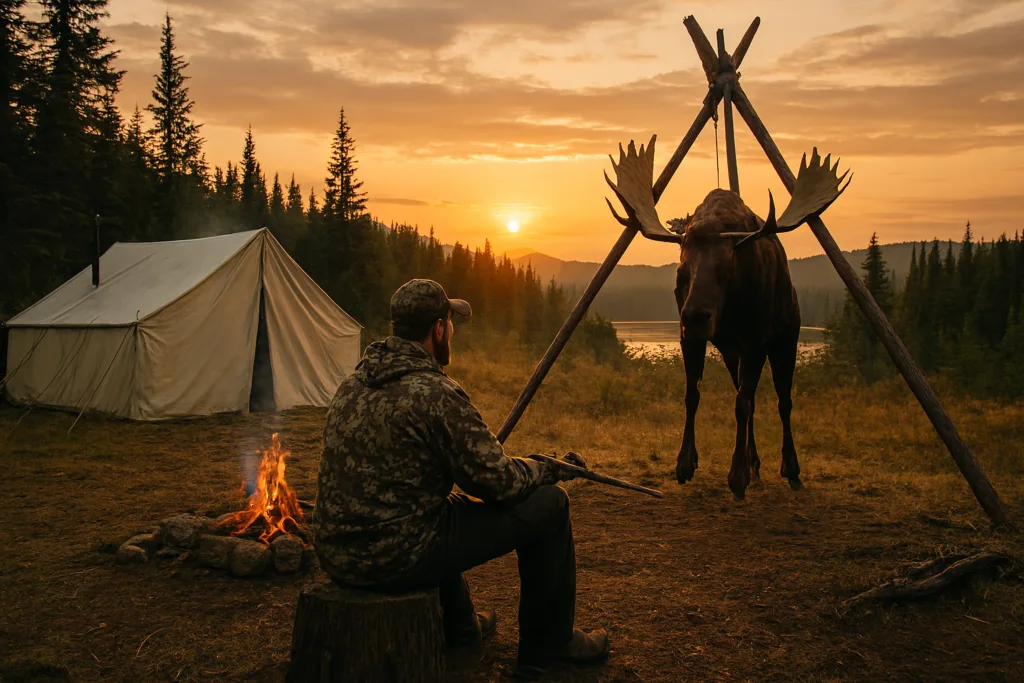
🏕️ 1. Wall Tent Basecamps (Canada + Interior Alaska)
Wall tents are the gold standard for traditional moose hunting camps. They offer the perfect balance of comfort, durability, and long-term livability.
Why Wall Tents Dominate Moose Country
- Withstand snow, wind, and freezing rain
- Support wood stoves for heat and drying gear
- Provide space for cooking, sleeping, and gear storage
- Can be set up for 10–20 day hunts
- Ideal for groups of 2–6 hunters
Typical Wall Tent Setup
- 12×14 or 14×16 canvas tent
- Internal frame or ridgepole setup
- Wood stove with spark arrestor
- Drying line for wet gear
- Cots with foam pads
- Lantern hooks and prep tables
- Vestibule or tarp extension for boots and packs
Best Regions for Wall Tent Camps
- Northern British Columbia
- Alberta boreal zones
- Ontario and Quebec backcountry
- Interior Alaska river-access zones
Wall tents are the backbone of Canadian moose hunting culture and remain the most versatile camp type for extended hunts.
🏔️ 2. Spike Camps (Remote Canada + Alaska)
Spike camps are minimalist, mobile, and strategically placed closer to active moose. They are essential when bulls are moving far from the main basecamp.
Why Spike Camps Matter
- Reduce travel time to prime habitat
- Allow hunters to stay on fresh sign
- Increase calling effectiveness at dawn and dusk
- Reduce pressure on moose near the main camp
Typical Spike Camp Setup
- Lightweight backpacking tents or tipi shelters
- Compact stoves or no stove at all
- Freeze‑dried meals
- Minimal gear (rifle, optics, tarp, sleeping system)
- Bear‑safe food storage
When Spike Camps Are Essential
- Moose are moving 3–6 miles from basecamp
- Terrain is too rugged for daily travel
- Weather windows are short
- Bulls are vocal but far from camp
Spike camps are where the grind happens — and where many of the biggest bulls are taken.
🛶 3. Boat‑Based Camps (Alaska + Yukon)
In Alaska and parts of the Yukon, rivers are the highways of moose country. Boat‑based camps allow hunters to move with the migration and access remote, untouched habitat.
Why Boat Camps Are So Effective
- Moose travel river corridors during the rut
- Boats allow silent, low‑impact access
- Camps can be repositioned daily
- Reduce pack‑out distances dramatically
Typical Boat Camp Setup
- 18–20 ft riverboat or jet boat
- Inflatable rafts for shallow tributaries
- Tent or tarp shelter on gravel bars
- Dry bags for all gear
- Portable stoves and compact cook kits
- Meat poles built from driftwood
Best Regions for Boat Camps
- Yukon River system
- Koyukuk, Innoko, and Nowitna rivers (Alaska)
- Remote BC river systems
Boat‑based camps are the most mobile and adaptive camp type — perfect for hunters who want to cover ground and stay ahead of pressure.
🏚️ 4. Cabin Camps (Canada)
In many Canadian provinces, especially in the east, cabin camps are a staple of moose hunting culture. These rustic structures offer warmth, shelter, and a sense of tradition.
Why Cabin Camps Work
- Provide reliable heat
- Offer protection from storms
- Allow for extended hunts
- Reduce setup and teardown time
- Ideal for groups and family hunts
Typical Cabin Camp Features
- Wood stove
- Bunk beds
- Propane cook stove
- Meat shed or hanging pole
- Generator for lights
- ATV or boat access
Best Regions for Cabin Camps
- Newfoundland & Labrador
- Quebec
- Ontario
- Northern Manitoba
Cabin camps are the most comfortable option — and often the most culturally rich.
📊 Table 4: Camp Types vs. Terrain Suitability
| Camp Type | Best Terrain | Mobility | Comfort | Ideal Regions |
|---|---|---|---|---|
| Wall Tent Basecamp | Boreal forest, river valleys | Medium | High | Canada, Interior Alaska |
| Spike Camp | Remote basins, muskeg, alpine | High | Low | BC, Yukon, Alaska |
| Boat‑Based Camp | River systems, floodplains | Very High | Medium | Alaska, Yukon |
| Cabin Camp | Forested regions, lakes | Low | Very High | Newfoundland, Quebec, Ontario |
🎒 Essential Gear for Moose Hunting Camps
Moose hunting requires gear that can withstand brutal weather, heavy loads, and long days in the field.
Camp Gear Essentials
- Canvas wall tent or 4‑season tent
- Wood stove or propane heater
- Chainsaw + fuel
- Water filtration system
- Tarp shelters
- Meat‑care supplies (game bags, citric spray)
- Satellite communicator
Hunting Gear Essentials
- .30‑06, .300 Win Mag, .338 Win Mag, or similar
- High‑quality optics (10×42 binoculars + spotting scope)
- Waterproof boots + hip waders
- Pack frame capable of 100+ lbs
- Calling tools (birch bark horn, grunt tube)
Safety Gear
- Bear spray
- First‑aid kit
- InReach or satellite phone
- Fire starter kit
- Extra fuel and food
For national safety recommendations, AdventureSmart Canada provides essential outdoor safety resources. “Lightweight backcountry hunting gear from Kings Camo”
🚚 Logistics: The Hidden Engine of Moose Hunting Success
Moose hunting logistics are complex and unforgiving. A successful camp requires:
1. Access Planning
- Boat routes
- ATV trails
- Fly‑in landing zones
- Portage routes
2. Meat Hauling Strategy
- Pack frames
- Sleds
- Rafts
- Game carts
3. Weather Contingency Plans
- Backup camp locations
- Extra tarps
- Emergency rations
- Storm‑proofing
4. Camp Rotation Strategy
- Move spike camps as bulls shift
- Adjust calling locations
- Rotate hunters to reduce pressure
💰 The Economic Engine Behind Moose Hunting Camps
Moose hunting is more than a tradition — it is a major economic driver across northern North America. Every moose hunting camp, whether a remote fly‑in operation or a family‑run cabin camp, contributes to a broader economic ecosystem that supports:
- Local outfitters
- Indigenous communities
- Bush pilots
- Guides and packers
- Gear manufacturers
- Fuel suppliers
- Rural tourism
- Conservation agencies
A single moose hunt can involve thousands of dollars in logistics, gear, travel, and services. In remote regions of Alaska, Yukon, and northern Canada, moose hunting is one of the few reliable seasonal revenue streams that sustain small communities and wilderness‑based businesses.
Economic Impact Breakdown
- Outfitted hunts: High‑value packages that support guides, pilots, cooks, wranglers, and camp staff
- DIY hunts: Fuel, gear, food, tags, and transportation purchases
- Local spending: Hotels, restaurants, general stores, and transport hubs
- Conservation funding: Tags, licenses, and fees directly support wildlife management
Moose hunting camps are not just cultural artifacts — they are economic lifelines. “Destination Canada’s outdoor tourism and fishing overview”
🌱 Conservation: The Foundation of Moose Hunting’s Future
Moose populations across North America are managed through one of the most sophisticated wildlife conservation systems in the world. The North American Model of Wildlife Conservation ensures that:
- Wildlife is held in the public trust
- Science guides management decisions
- Hunters fund conservation
- Harvest is regulated and sustainable
- Habitat is protected for future generations
Moose hunting camps play a direct role in this system. Every tag purchased, every license issued, and every outfitted hunt booked contributes to:
- Habitat restoration
- Predator‑prey studies
- Population monitoring
- Disease research
- Enforcement of regulations
- Conservation officer programs
Key Conservation Challenges
Moose face several modern pressures:
- Predation: Wolves and bears impact calf survival
- Climate change: Warmer winters increase parasite loads
- Habitat loss: Logging and development fragment migration routes
- Disease: Winter ticks and brainworm in some regions
- Human access: Roads increase pressure in previously remote areas
Moose hunting camps must adapt to these realities to remain sustainable.
🧭 How Moose Hunting Camps Support Conservation
Moose camps are more than hunting bases — they are boots‑on‑the‑ground conservation hubs.
1. Data Collection
Hunters and outfitters provide critical field data:
- Bull age structure
- Antler measurements
- Cow‑calf ratios
- Predator sightings
- Habitat conditions
2. Ethical Harvest
Selective harvest of mature bulls:
- Protects breeding cows
- Maintains genetic diversity
- Supports long‑term population stability
3. Habitat Stewardship
Camps often maintain:
- Trails
- Water access points
- Firewood areas
- Minimal‑impact camp practices
4. Funding
Hunters remain the largest financial contributors to wildlife conservation in North America.
🔮 The Future of Moose Hunting Camps
Moose hunting camps are evolving. The next decade will bring significant changes driven by:
1. Climate Adaptation
Warmer temperatures will shift:
- Rut timing
- Moose movement
- Habitat distribution
- Insect pressure
Camps will need to adjust locations, timing, and logistics.
2. Technology Integration
Modern camps are adopting:
- Satellite communication
- Solar charging systems
- Lightweight shelters
- High‑efficiency stoves
- Digital mapping tools
Technology will never replace wood smoke and canvas, but it will enhance safety and efficiency.
3. Access Management
Governments and wildlife agencies are increasingly:
- Restricting motorized access
- Limiting tag allocations
- Protecting migration corridors
- Managing predator populations
Camps will need to adapt to new regulations and access patterns.
4. Cultural Preservation
Moose hunting camps are part of northern identity. As younger generations enter the sport, camps will become:
- More inclusive
- More educational
- More conservation‑focused
- More connected to Indigenous knowledge
The future of moose hunting camps is not just about harvesting bulls — it’s about preserving a way of life.
🏹 Conclusion: The Legacy of Moose Hunting Camps
Moose hunting camps are the beating heart of northern hunting culture. They are where:
- Families bond
- Hunters learn
- Traditions are passed down
- Conservation is practiced
- Wilderness is respected
From the tundra of Alaska to the boreal forests of Canada, these camps represent something rare in the modern world: a place where people reconnect with the land, with each other, and with the timeless pursuit of the North’s most iconic big‑game animal.
Moose hunting camps are not fading — they are evolving, strengthening, and becoming more essential than ever.
And North Hunt Fish Club stands at the center of that evolution.
Top 10 Moose Hunting Camp Questions — Answered
1. What is the best type of camp for a moose hunt?
The best camp depends on the terrain and access.
- Wall tents are ideal for boreal forest and river valleys.
- Boat‑based camps dominate in Alaska and Yukon river systems.
- Spike camps excel in remote basins where moose are far from basecamp.
- Cabin camps are perfect for regions like Newfoundland, Quebec, and Ontario.
If you want comfort and long-term stability, choose a wall tent. If you want mobility and access to untouched habitat, choose a boat‑based or spike camp.
2. How long should a moose hunt be?
Most successful moose hunts run 7–14 days, depending on region and population density.
- High‑density regions (Yukon, Newfoundland): 5–7 days is often enough.
- Low‑density regions (Ontario south, BC interior): 10–14 days is recommended.
Weather delays, pack‑outs, and bull movement patterns all require extra time.
3. What gear is essential for a moose hunting camp?
A moose camp must withstand harsh weather and heavy workloads. Essentials include:
- 4‑season tent or canvas wall tent
- Wood stove or propane heater
- Chainsaw + fuel
- Waterproof boots + hip waders
- Satellite communicator
- Game bags + meat‑care supplies
- High‑calorie food and backup rations
Moose hunting is gear‑intensive — cutting corners leads to failed hunts.
4. How far from camp do you typically find moose?
Moose may be within 500 yards of camp in high‑density regions, or 5–10 miles away in low‑density areas. Key factors include:
- Habitat quality
- Hunting pressure
- Rut timing
- Weather
In Alaska, bulls often travel river corridors, making boat camps extremely effective.
5. What caliber is best for moose hunting?
The most trusted moose calibers are:
- .30‑06 Springfield
- .300 Win Mag
- .338 Win Mag
- 7mm Rem Mag
Shot placement matters more than caliber, but moose are massive animals — choose a cartridge with deep penetration and controlled expansion.
6. How do weather conditions affect moose movement?
Moose are highly sensitive to heat.
- Warm weather (above 10°C / 50°F): Movement drops sharply.
- Cold weather: Bulls move aggressively during the rut.
- Heavy rain: Moose bed down in timber.
- Wind: Bulls seek sheltered basins.
Camp placement must account for wind, shade, and access to cool, wet habitat.
7. What is the best time of year for a moose hunt?
The peak moose hunting period is late September to mid‑October, aligning with the rut. During this time:
- Bulls respond to calling
- Movement increases
- Antler displays are at their peak
- Bulls travel long distances seeking cows
Early September can be productive in northern regions; late October is best for post‑rut feeding patterns.
8. How do you keep meat safe in a moose camp?
Moose quarters must be cooled quickly and protected from predators. Best practices include:
- Hanging quarters on a meat pole
- Using breathable game bags
- Keeping meat shaded and off the ground
- Applying citric acid spray
- Avoiding plastic bags (they trap heat)
In warm weather, hunters may need to move meat to a cooler area or transport it daily.
9. How do you choose a safe and effective camp location?
A good moose camp location includes:
- High ground with good drainage
- Access to water
- Wind protection
- Proximity to moose habitat (willow flats, burns, river bottoms)
- Safe distance from bear travel routes
- Enough space for tents, meat poles, and gear
Avoid low bogs, exposed ridges, and areas with heavy deadfall.
10. What is the biggest mistake hunters make in moose camps?
The most common mistake is placing the camp too far from active moose habitat. Other major errors include:
- Overcalling or calling at the wrong times
- Poor meat‑care planning
- Underestimating pack‑out distances
- Bringing insufficient gear
- Ignoring wind direction
- Hunting too close to camp and educating bulls
Success comes from preparation, patience, and understanding moose behavior.